




How to Apply
Conditions
-USDA Zones: 3–7
-Sun: 4–6 hours ideal; 3 hours minimum (red fescue carries some shade)
-Soil pH: 5.5–7.0 (tolerates acidic sandy soils); sandy, sandy loam, gravelly, or coastal — excellent drainage (not heavy clay)
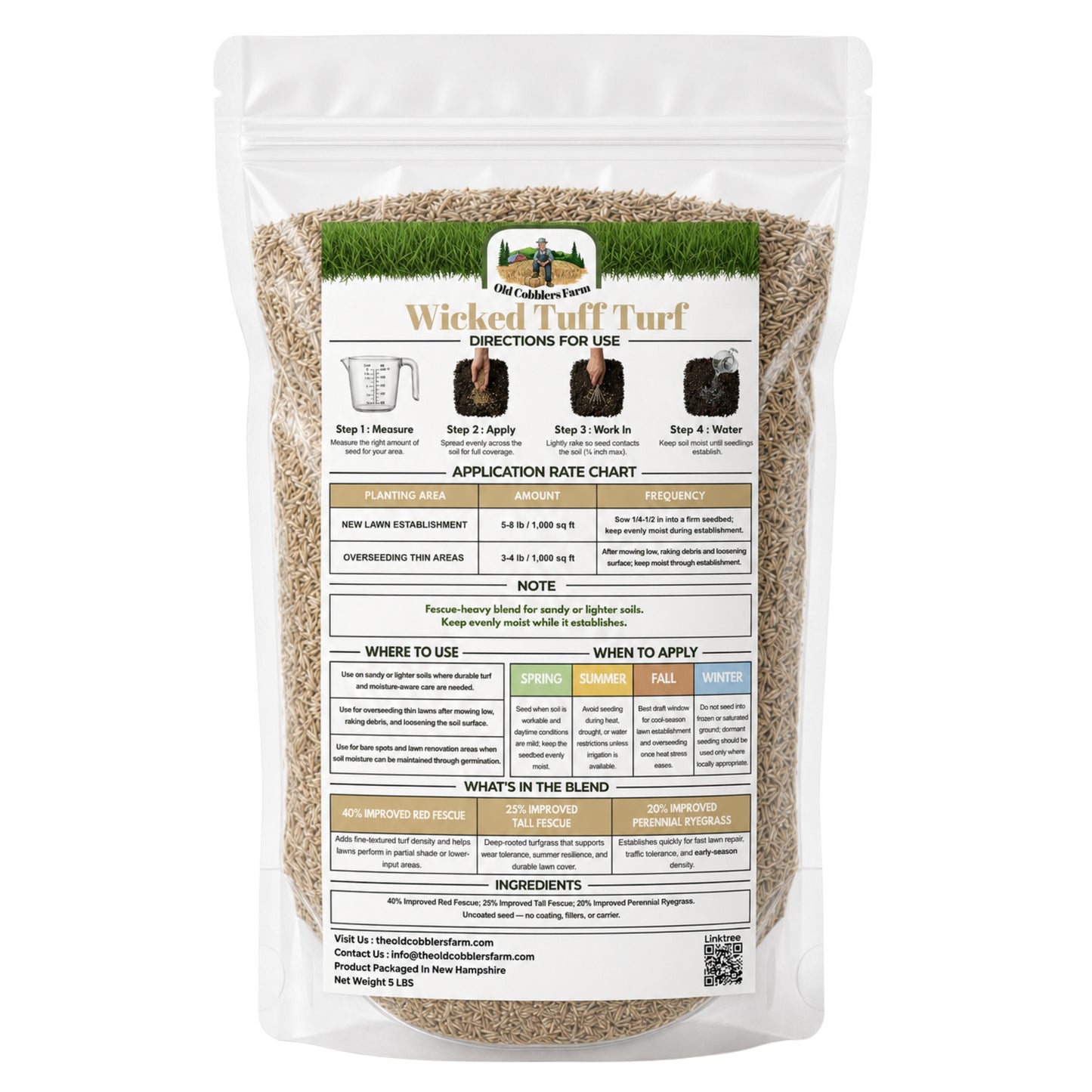
Seeding Rate (per 1,000 sq ft and per acre)
-New lawns: 6–8 lb per 1,000 sq ft (≈ 260–350 lb per acre)
-Overseeding: 3–4 lb per 1,000 sq ft (≈ 130–175 lb per acre)
-Very sandy soils: increase the rate 10–15%
How to Plant
Rake the seed lightly into the top of the soil for good seed-to-soil contact — do not bury deep — and keep it moist while it establishes (annual ryegrass in 5–7 days, perennial ryegrass 7–10, red and tall fescue 14–21, white clover slowest at 21–35). On sand, water lightly and often (it can’t hold deep water) and ideally early morning to limit evaporation. Mow high at 3.5–4.0 inches — critical on sand — and never remove more than 1/3 of the blade. Feed lightly in multiple small doses (heavy doses leach straight through sand); slow-release organic fertilizers outperform synthetics here, and the clover provides 0.5–1.5 lb of nitrogen on its own, so total nitrogen needs are only about 1–2 lb per 1,000 sq ft a year.
Clover Inoculation (optional)
The white clover is uncoated and not pre-inoculated. The Rhizobium bacteria clover needs to fix nitrogen are usually present in established soils, but on poor or freshly disturbed sandy soils a clover/Rhizobium (R. trifolii) inoculant at seeding helps ensure reliable nodulation.
-USDA Zones: 3–7
-Sun: 4–6 hours ideal; 3 hours minimum (red fescue carries some shade)
-Soil pH: 5.5–7.0 (tolerates acidic sandy soils); sandy, sandy loam, gravelly, or coastal — excellent drainage (not heavy clay)
Seeding Rate (per 1,000 sq ft and per acre)
-New lawns: 6–8 lb per 1,000 sq ft (≈ 260–350 lb per acre)
-Overseeding: 3–4 lb per 1,000 sq ft (≈ 130–175 lb per acre)
-Very sandy soils: increase the rate 10–15%
How to Plant
Rake the seed lightly into the top of the soil for good seed-to-soil contact — do not bury deep — and keep it moist while it establishes (annual ryegrass in 5–7 days, perennial ryegrass 7–10, red and tall fescue 14–21, white clover slowest at 21–35). On sand, water lightly and often (it can’t hold deep water) and ideally early morning to limit evaporation. Mow high at 3.5–4.0 inches — critical on sand — and never remove more than 1/3 of the blade. Feed lightly in multiple small doses (heavy doses leach straight through sand); slow-release organic fertilizers outperform synthetics here, and the clover provides 0.5–1.5 lb of nitrogen on its own, so total nitrogen needs are only about 1–2 lb per 1,000 sq ft a year.
Clover Inoculation (optional)
The white clover is uncoated and not pre-inoculated. The Rhizobium bacteria clover needs to fix nitrogen are usually present in established soils, but on poor or freshly disturbed sandy soils a clover/Rhizobium (R. trifolii) inoculant at seeding helps ensure reliable nodulation.
