
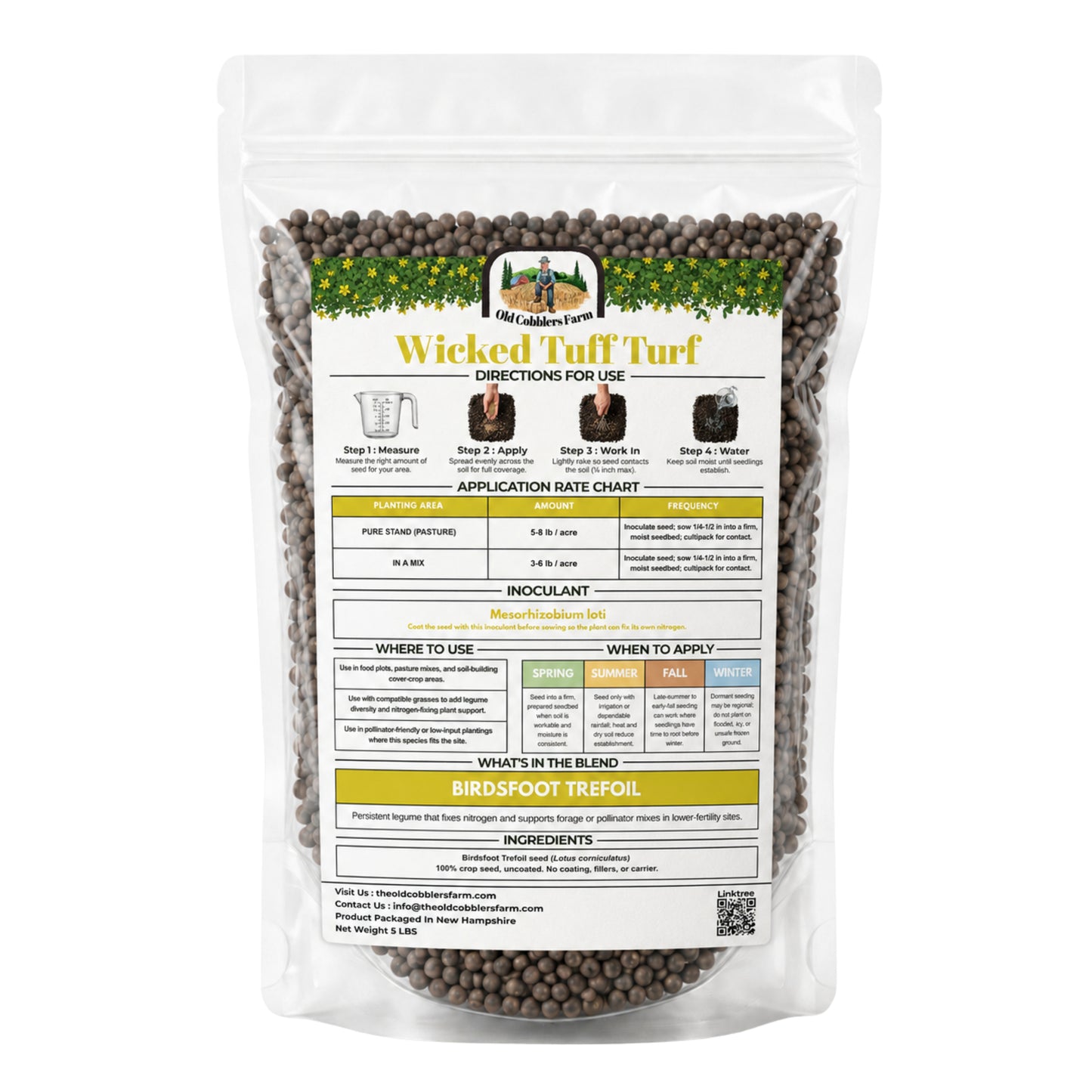
Wicked Tuff Turf Birdsfoot Trefoil Seed
Couldn't load pickup availability
Product Description
Product Description
The safe, tough pasture legume — it won't cause bloat, it thrives on ground that defeats alfalfa, and it comes back on its own for a decade.
Birdsfoot Trefoil (Lotus corniculatus) is a long-lived perennial — a single stand can persist 5–10+ years, reseeding itself to stay dense. Its standout trait is that it is non-bloating: most lush legumes can cause bloat (a dangerous build-up of gas in grazing cattle and sheep), but Birdsfoot Trefoil does not, so you can graze it safely. It also contains condensed tannins — natural plant compounds that are associated with lower internal parasite loads in grazing livestock, which is why organic and low-input graziers value it. As a legume it does nitrogen fixation, pulling 50–100 lbs of nitrogen per acre from the air into the soil. And it tolerates wet, acidic, low-fertility, and moderately salty ground where alfalfa and most clovers fail. Our seed is uncoated and tested for purity and germination.
Key Benefits
• Bloat-safe grazing: one of the few pasture legumes that does not cause bloat in cattle and sheep.
• Natural herd support: condensed tannins are associated with reduced internal parasite loads in grazers.
• Thrives on tough ground: wet, acidic, low-fertility, and moderately saline soils.
• Long-lived & self-reseeding: a productive stand for 5–10+ years.
• Soil builder: fixes 50–100 lbs of nitrogen per acre a year.
• Clean, uncoated seed: no fillers, coatings, or dyes.
Best Uses
• Bloat-safe pasture and grazing systems
• Marginal land improvement and reclamation
• Roadside, conservation, and DOT plantings
• Wildlife food plots and deer habitat
• Low-input, sustainable forage programs
Important Notes
Be patient in year one: Birdsfoot Trefoil establishes slowly compared to clovers. Prepare a firm seedbed, sow shallow (surface to ¼ inch), and plant with a nurse crop such as oats to suppress weeds while it gets going. Full production comes in year two.
Use the right inoculant: Birdsfoot Trefoil needs Mesorhizobium loti, the bacteria specific to Lotus. Clover inoculant (Rhizobium trifolii) will NOT nodulate it, which would mean poor nitrogen fixation. It is a pasture and forage crop, not a residential lawn — it has low foot-traffic tolerance.
Why Choose Old Cobblers Farm™?
Every bag of Wicked Tuff Turf seed is selected for high purity and strong germination, and tested so you know what you are planting — consistent, clean, uncoated seed for growers managing tough ground where other legumes fail.
Application Instructions
USDA Zones 3–7; full sun to partial shade; clay, sandy, gravelly, or low-fertility soils; pH 5.5–7.5; tolerates poorly drained, moderately wet, and moderately saline ground.
Seeding rate: 6–10 lb per acre for a pure stand; 3–5 lb per acre in a pasture mix.
How to plant
Prepare a firm seedbed and drill or broadcast no deeper than ¼ inch (surface sowing works well). Plant in early spring (preferred) or late summer. It establishes slowly — use a nurse crop such as oats to suppress weeds in year one, and expect full production in year two. Germinates in 7–14 days.
Inoculation
Inoculate before planting with Mesorhizobium loti — the inoculant specific to Lotus. Do NOT use clover inoculant (Rhizobium trifolii); it will not nodulate Birdsfoot Trefoil. Inoculation means coating the seed with the right helper bacteria so the legume can pull nitrogen from the air properly.
Ingredients
Ingredients
100% pure seed, no fillers, coatings, or dyes.
Product Specifications
Species: Birdsfoot Trefoil (Lotus corniculatus)
Category: Legume (nitrogen-fixing, non-bloating)
Lifecycle: Perennial (5–10+ years); reseeds naturally
Growth habit: Semi-prostrate to upright
USDA Zones: 3–7
Sun: Full sun to partial shade
Soil pH: 5.5–7.5 (wider tolerance than alfalfa)
Drainage: Tolerates poorly drained and moderately wet soils
Seeding
Rate — pure stand: 6–10 lb/acre
Rate — in mix: 3–5 lb/acre
Depth: Surface to ¼ inch
Establishment: Slow in year one — use a nurse crop; full production year 2
Best planting time: Early spring (preferred) or late summer
Germination window: 7–14 days (soil 50–70°F)
Inoculant: Mesorhizobium loti (Lotus-specific — not clover inoculant)
Fertilizer note: Seed only — naturally fixes 50–100 lbs N/acre
Seed Quality
Purity: 95–98%
Germination: 85–90%
Weed seed: <0.5%
Other crop seed: ≤0.5%
Inert matter: 2–4%
Share

How to Apply
USDA Zones 3–7; full sun to partial shade; clay, sandy, gravelly, or low-fertility soils; pH 5.5–7.5; tolerates poorly drained, moderately wet, and moderately saline ground.
Seeding rate: 6–10 lb per acre for a pure stand; 3–5 lb per acre in a pasture mix.
How to plant
Prepare a firm seedbed and drill or broadcast no deeper than ¼ inch (surface sowing works well). Plant in early spring (preferred) or late summer. It establishes slowly — use a nurse crop such as oats to suppress weeds in year one, and expect full production in year two. Germinates in 7–14 days.
Inoculation
Inoculate before planting with Mesorhizobium loti — the inoculant specific to Lotus. Do NOT use clover inoculant (Rhizobium trifolii); it will not nodulate Birdsfoot Trefoil. Inoculation means coating the seed with the right helper bacteria so the legume can pull nitrogen from the air properly.