
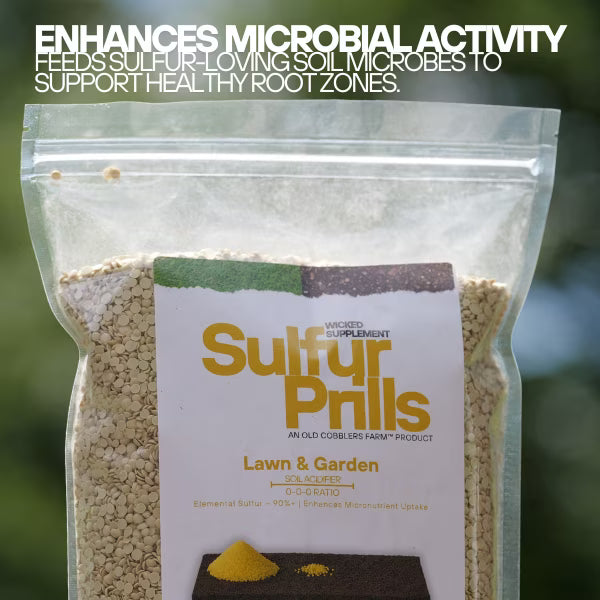
Sulfur Prills OMRI
Sulfur Prills OMRI
Couldn't load pickup availability
Product Description
Product Description
Slow-Release Elemental Sulfur — a Gentle, Long-Lasting Soil Acidifier
Old Cobblers Farm Sulfur Prills are a slow-release soil acidifier made from 100% elemental sulfur. They gradually lower soil pH to create the acidic conditions that blueberries, azaleas, rhododendrons and other acid-loving plants prefer. Because the sulfur must first be converted in the soil by naturally occurring bacteria, the acidification is gradual and long-lasting — which lowers the risk of over-acidifying compared with fast-acting products.
As the soil becomes more acidic, certain nutrients — iron in particular — become more available to acid-loving plants, which is why correcting pH often greens up plants that were struggling in alkaline soil. Elemental sulfur also supplies sulfur, a secondary plant nutrient. It is a soil amendment rather than a complete fertilizer, so pair it with a fertilizer for feeding.
The prilled form is low-dust and easy to spread or work into the soil. Always start with a soil test to set the right rate, work the prills in, and water. Acidification develops over weeks to months, and a single application typically lasts a good while — reapply only as a soil test indicates.
Where to use it: blueberries, azaleas, rhododendrons and other acid-loving plants, plus general soil-test-guided pH lowering in beds, vegetable gardens and lawns.
Key Benefits
• Lowers Soil pH Gradually: Creates acidic conditions for acid-loving plants — slowly and steadily.
• Slow-Release & Long-Lasting: Converts in the soil over time, so effects are consistent and durable.
• Lower Over-Acidification Risk: The gradual action makes it harder to overshoot than fast-acting acidifiers.
• Improves Iron Availability: Acidic soil makes nutrients like iron more available to acid-loving plants.
• Supplies Sulfur: Elemental sulfur is also a secondary plant nutrient.
• Low-Dust Prills: The prilled form spreads cleanly and works into the soil easily.
• Generally Organic-Accepted: Elemental sulfur is a material commonly allowed in organic gardening (confirm certification).
Best Uses
• Blueberries and other acid-loving fruit
• Azaleas, rhododendrons and acid-loving ornamentals
• Lowering pH in alkaline garden beds
• Vegetable beds at preparation (soil-test guided)
• Lawns on alkaline or hard-water soils
• Gardeners and growers wanting gradual, low-risk acidification
Important Notes / Safety
• Soil-Test First: Test your soil pH before applying to set the right rate, and re-test before reapplying.
• It Works Gradually: Acidification develops over weeks to months as soil bacteria convert the sulfur — don’t expect an immediate pH change.
• Lower Risk, Not Zero: The slow release reduces the chance of over-acidifying, but you can still overshoot with heavy or repeated use — follow the rate and re-test.
• It’s an Amendment, Not a Fertilizer: It adjusts pH and supplies sulfur, but has no nitrogen, phosphorus or potassium — feed separately.
• Reapply Sparingly: A single application lasts a good while; the copy suggests every 2–3 years — let a soil test guide reapplication.
• Handle & Store Safely: Keep prills dry and away from heat and ignition sources (sulfur dust is combustible). Wash hands after handling and keep away from children and pets.
Why Choose Old Cobblers Farm™?
When you want to lower soil pH without the risk of overshooting, elemental sulfur is the gentle, dependable choice. Our Sulfur Prills convert slowly in the soil for steady, long-lasting acidification — ideal for blueberries, azaleas and other acid-lovers — and the low-dust prills are easy to apply. Soil-test first, work them in, and let time do the rest.
Application Instructions
-Acid-loving plants: 1–2 tablespoons per plant, sprinkled evenly around the base
-Vegetable gardens: 1–2 lbs per 100 sq ft, mixed in at bed preparation
-Lawns: 5–10 lbs per 1,000 sq ft, worked in and watered thoroughly
-Maintenance: reapply roughly every 2–3 years as a soil test indicates
Step by step
1. Test your soil pH first to choose the right rate.
2. Apply the rate for your plant or area (see the rate table).
3. Work the prills into the soil — before planting where possible.
4. Water after applying to settle them in.
5. Allow weeks to months for the pH to change as the sulfur converts.
6. Re-test before reapplying — generally only every 2–3 years.
What not to do
Do not expect an instant pH change (it works gradually), do not over-apply or reapply without re-testing, do not treat it as a fertilizer (it has no NPK), and keep the prills dry and away from heat or ignition sources.
Ingredients
Ingredients
No N-P-K — This is a soil amendment, not a fertilizer — it adjusts pH and adds sulfur rather than supplying nitrogen, phosphorus or potassium.
Product Specifications
-Category: soil amendment — supplies sulfur; no NPK
-Ingredient: 100% elemental sulfur (prilled)
-Action: slow-release — gradual, long-lasting pH reduction
-Best for: blueberries, azaleas, rhododendrons, acid-loving plants
-Advantage: low over-acidification risk; low-dust prills vs. aluminum sulfate: slower and gentler; preferred for general long-term acidifying
-Reapply: ~every 2–3 years (soil-test guided)
Share

How to Apply
-Acid-loving plants: 1–2 tablespoons per plant, sprinkled evenly around the base
-Vegetable gardens: 1–2 lbs per 100 sq ft, mixed in at bed preparation
-Lawns: 5–10 lbs per 1,000 sq ft, worked in and watered thoroughly
-Maintenance: reapply roughly every 2–3 years as a soil test indicates
Step by step
1. Test your soil pH first to choose the right rate.
2. Apply the rate for your plant or area (see the rate table).
3. Work the prills into the soil — before planting where possible.
4. Water after applying to settle them in.
5. Allow weeks to months for the pH to change as the sulfur converts.
6. Re-test before reapplying — generally only every 2–3 years.
What not to do
Do not expect an instant pH change (it works gradually), do not over-apply or reapply without re-testing, do not treat it as a fertilizer (it has no NPK), and keep the prills dry and away from heat or ignition sources.
