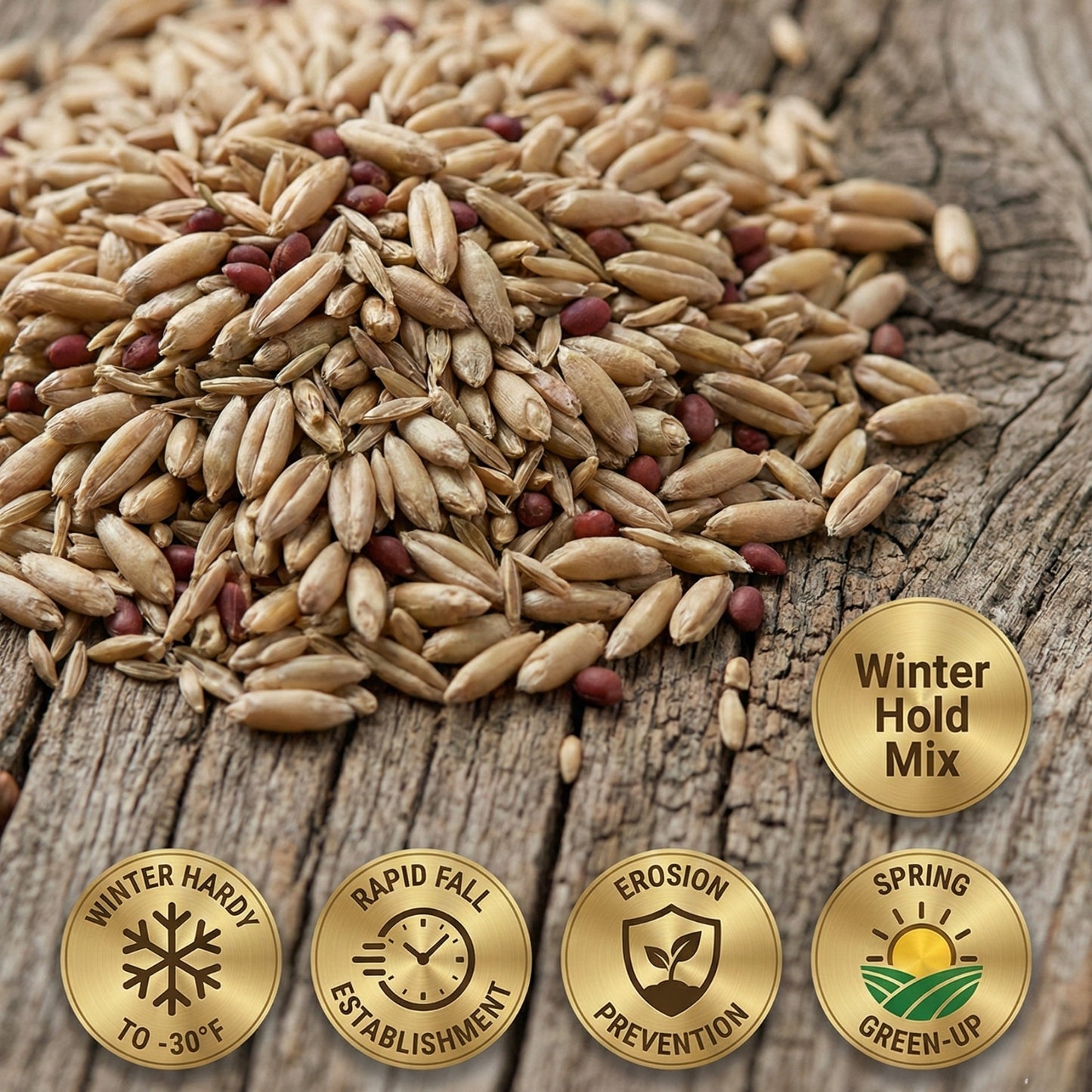
Wicked Tuff Turf Winter Hold Seed Mix
Wicked Tuff Turf Winter Hold Seed Mix
Couldn't load pickup availability
Product Description
Product Description
The fall seeding window has closed, the ground’s about to sit bare all winter — and you still need cover. This is the mix that germinates anyway.
Old Cobblers Farm™ Wicked Tuff Turf Winter Hold Mix is a cold-season cover-crop blend built around 87% winter rye. Winter rye germinates at soil temperatures as low as 34°F — conditions that shut down every standard lawn grass — so it puts down fast green cover to control erosion on fall-disturbed or bare soil through late fall and winter.
Important: what this is (and what it isn’t)
This is NOT a permanent lawn — it’s a temporary, two-phase cover crop. Winter rye (Secale cereale) is a cereal grain like wheat, not a turfgrass, and it is NOT the same plant as perennial or annual ryegrass. It grows tall (3–4 feet if left unmowed), holds the soil over winter, then produces seed heads and dies in late spring once it completes its annual lifecycle. As the rye fades, the small permanent portion of the blend (creeping red fescue and perennial ryegrass, with nitrogen-fixing red clover) establishes. Because that permanent share is small, plan to overseed with a standard lawn mix if you want a full, lasting lawn.
How the two phases work
• Fall / early winter: winter rye germinates fast, giving green cover and erosion control when it’s too cold for turfgrass.
• Winter: the rye grows slowly, holding the soil in place.
• Early spring: the rye resumes growth; perennial ryegrass, creeping red fescue, and red clover begin establishing.
• Late spring: the rye heads out and dies; the permanent species fill in where it was.
Key Benefits
• Cold germination: sprouts at soil temps as low as 34°F.
• Erosion control: fast cover for fall-disturbed and bare soil.
• Dormant-seeding ready: sow Dec–Feb for early-spring establishment.
• Nitrogen-fixing: red clover adds nitrogen, easing spring fertilizer needs.
• Adaptable: winter rye tolerates poor soils and harsh cold.
Best Uses
• Late-fall seeding after the standard turf window closes
• Dormant seeding (December–February) for early-spring establishment
• Post-construction erosion control on fall projects
• Ground that would otherwise sit bare over winter
• Cover-crop use in lawn/garden and field transitions
Important Notes
• ⚠ Not a permanent lawn: this is a temporary cover crop. Winter rye grows tall and dies in late spring; overseed with a standard lawn mix for a full permanent lawn.
• ⚠ Winter rye ≠ ryegrass: winter rye (Secale cereale) is a cereal grain, not the turfgrass called perennial/annual ryegrass.
• Plant in the right window — late fall or dormant (Dec–Feb), not spring or summer (use a standard lawn mix then).
• Traffic is low-to-moderate — avoid traffic during establishment and transition; winter rye is not a wear-tolerant turf.
• Expect tall growth (up to 3–4 ft) before heading if unmowed — not for sites where that’s unacceptable.
• Seed only — not a fertilizer.
Why Choose Old Cobblers Farm™?
This blend does one job extremely well — establishing cover when nothing else can. By leading with cold-germinating winter rye and carrying a small permanent-species transition plus nitrogen-fixing clover, it protects bare soil through winter and hands off to permanent grass in spring.
Application Instructions
Application Instructions
-USDA Zones: 3–7
-Primary window: late October through December (after the turfgrass seeding window closes)
-Dormant seeding: December through February (seed lies dormant, germinates in early spring)
-Germinates at soil temperatures as low as 34°F; soil pH 5.5–7.0 (highly adaptable; moderate drainage)
Seeding Rate (per 1,000 sq ft and per acre)
-New seeding: 4–6 lb per 1,000 sq ft (≈ 175–260 lb per acre)
-Overseeding: 3–4 lb per 1,000 sq ft (≈ 130–175 lb per acre)
How to Plant & Mow Through the Transition
Rake the seed lightly into the top of the soil for good seed-to-soil contact and water until established. Winter rye emerges in 5–10 days even in cold conditions; perennial ryegrass follows in 10–21 days if soil is above 50°F; creeping red fescue and red clover establish as the soil warms in spring. Mowing through the transition: mow the winter rye to 3–4 inches once it reaches 5–6 inches; when it begins heading in late spring, mow short (2–3 inches) to reduce its competition with the permanent species; after the transition, return to a normal 3–3.5 inch height. Winter rye has low fertility needs — apply a starter fertilizer in early spring as the permanent species establish; the red clover fixes nitrogen, easing spring fertilizer needs.
Clover Inoculation (optional)
The red clover is uncoated and not pre-inoculated. The Rhizobium bacteria clover needs to fix nitrogen are usually present in established soils, but on poor or freshly disturbed ground a clover/Rhizobium (R. trifolii) inoculant at seeding helps reliable nodulation.
Ingredients
Ingredients
-87% Winter Rye (Secale cereale): temporary cereal cover crop — cold germination, winter cover, erosion control; dies in late spring (not a turfgrass)
-5% Creeping Red Fescue: permanent transition species — fine texture, soil-binding, shade tolerance
-4% Perennial Ryegrass: permanent transition species — quick green-up and density
-4% Medium Red Clover: nitrogen-fixing legume — natural fertility, eases spring feeding
No coatings, dyes, or fillers. Clover is uncoated (not pre-inoculated).
Product Specifications
Product Specifications
-Composition: 4-species cover-crop blend (87% winter rye + creeping red fescue, perennial ryegrass, red clover)
-Category: Winter-rye cover crop — late-fall / dormant seeding
-Permanent lawn?: No — temporary, two-phase cover crop; overseed with a lawn mix for a full lawn
-Lifecycle: Winter rye = annual (dies late spring); transition species = perennial
-USDA Zones: 3–7
-Germination temp: As low as 34°F (winter rye)
-Planting window: Late Oct–Dec; dormant Dec–Feb
-Soil pH: 5.5–7.0 (highly adaptable; moderate drainage)
-Mowing (transition): Rye to 3–4 in at 5–6 in; 2–3 in at heading; then 3–3.5 in
-Traffic: Low-to-moderate — avoid during establishment/transition (not wear-tolerant)
-NPK: Seed only — not a fertilizer; red clover fixes nitrogen
Seeding & Establishment
-Rate (new seeding): 4–6 lb / 1,000 sq ft (≈ 175–260 lb/acre)
-Rate (overseeding): 3–4 lb / 1,000 sq ft (≈ 130–175 lb/acre)
-Establishment: Winter rye emerges 5–10 days; permanent species 4–8 weeks after spring warmup; full transition 12–18 months
Seed Quality
-Purity: coatings/dyes/fillers
-Clover treatment: Uncoated — not pre-inoculated (optional Rhizobium inoculant)
Share