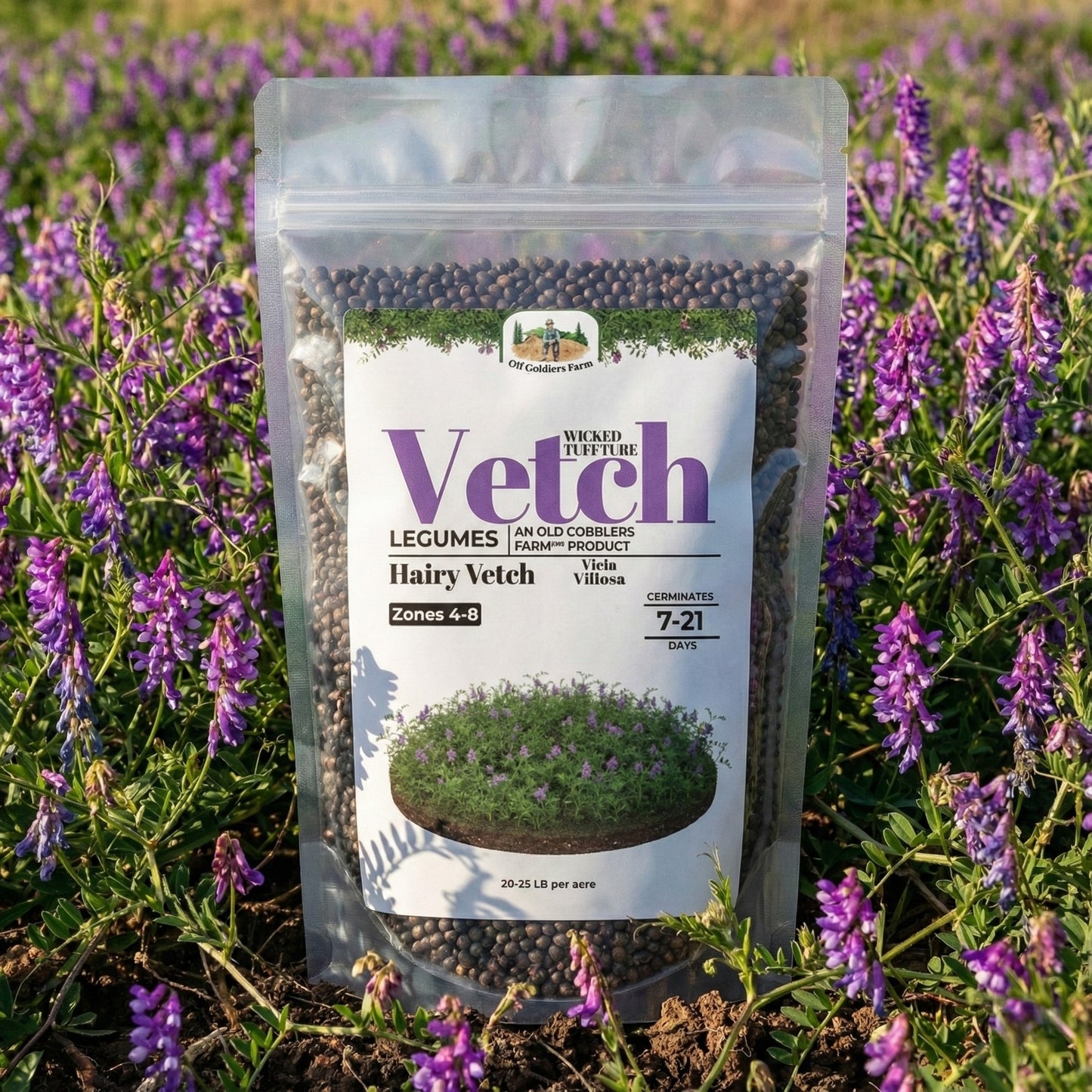
Wicked Tuff Turf Hairy Vetch Seed - Vicia Villosa
Wicked Tuff Turf Hairy Vetch Seed - Vicia Villosa
Couldn't load pickup availability
Product Description
Product Description
The winter cover-crop workhorse — plant it once in fall and it overwinters, smothers weeds, and fixes its own nitrogen to leave your soil rich by spring.
Hairy Vetch (Vicia villosa) is a winter annual — you plant it in late summer or fall, it overwinters as a low rosette (a flat cluster of leaves close to the ground), and it surges into growth in spring. That overwintering habit is what makes it special: it survives freezing temperatures down to USDA Zone 3 and protects bare soil through the cold months. As a legume it does nitrogen fixation — pulling nitrogen out of the air into the soil, 100–200 lbs per acre — so the next cash crop needs less fertilizer. It grows as dense, climbing, sprawling vines with tendrils that grab companion plants like cereal rye, forming a mat that smothers weeds and shields soil from erosion. At full bloom you terminate it (roll, mow, or till it in) and that spring biomass becomes green manure — a crop worked back into the soil to enrich it. Our seed is uncoated and tested for purity and germination.
Key Benefits
• Winter-hardy: fall-planted, survives to USDA Zone 3, protecting soil all winter.
• Heavy nitrogen fixer: 100–200 lbs of nitrogen per acre for the following crop.
• Explosive spring biomass: builds dark, rich topsoil when terminated.
• Weed suppression: dense vining growth smothers winter and spring weeds.
• Cocktail-ready: the classic partner for winter rye and oats.
• Clean, uncoated seed: no fillers, coatings, or dyes.
Best Uses
• Winter cover crop and erosion protection
• Green manure and nitrogen for the following crop
• Weed suppression in crop rotations
• Cover-crop cocktail mixes with cereal grains
• Forage and grazing for livestock (see grazing note)
Important Notes
Plant Hairy Vetch in late summer/early fall so it can establish before winter and overwinter for spring growth. It is an aggressive vining cover crop and forage — not a residential lawn, and not suited to foot traffic. Inoculate with the vetch/pea inoculant (Rhizobium leguminosarum bv. viciae), not clover or alfalfa inoculant. Note for warmer regions: well-established Hairy Vetch can become weedy by self-seeding if not terminated before it sets seed — terminate at bloom.
Grazing note: Hairy Vetch can be grazed as high-protein forage before termination, but introduce livestock gradually. Hairy Vetch in particular has occasionally been linked to toxicity in some cattle and horses around flowering/seed set — if you plan to graze heavily, check current local extension guidance.
Why Choose Old Cobblers Farm™?
Every bag of Wicked Tuff Turf seed is selected for high purity and strong germination, and tested so you know what you are planting — consistent, clean, uncoated seed for cover-crop managers who demand performance.
Application Instructions
Application Instructions
USDA Zones 3–9; full sun to partial shade; sandy, loam, or clay soils including poor ground; pH 5.5–7.5; well-drained preferred.
Seeding rate
20–30 lb per acre for a pure stand; 10–20 lb per acre in a cereal mix (about 50/50 vetch to rye by seeding rate).
How to plant
Drill (preferred for even stands) or broadcast followed by light incorporation, ½–1 inch deep. Plant in late summer/early fall so it establishes and overwinters. Germinates in 7–14 days; it overwinters as a low rosette and surges in spring.
Termination
For the most nitrogen return, terminate at full spring bloom by roll-crimping, mowing, or incorporating into the soil. Terminating before seed set also prevents volunteer reseeding.
Inoculation
Inoculate before planting with Rhizobium leguminosarum biovar viciae — the inoculant for vetch and peas. Inoculation means coating the seed with the right helper bacteria so the legume can pull nitrogen from the air properly. (Clover and alfalfa inoculants will not work on vetch.)
Ingredients
Ingredients
Product Specifications
Product Specifications
Species: Hairy Vetch (Vicia villosa)
Category: Legume (nitrogen-fixing cover crop)
Lifecycle: Winter annual (fall-planted, overwintering)
Growth habit: Vining, climbing, sprawling; tendrils grip companions
USDA Zones: 3–9
Sun: Full sun to partial shade
Soil pH: 5.5–7.5
Seeding
Rate — pure stand: 20–30 lb/acre
Rate — in rye/oat mix: 10–20 lb/acre
Depth: ½–1 inch
Best planting time: Late summer/early fall (for overwintering)
Germination window: 7–14 days (soil 40–65°F)
Termination: Full spring bloom — roll-crimp, mow, or incorporate
Inoculant: Rhizobium leguminosarum bv. viciae (vetch/pea group)
Fertilizer note: Seed only — naturally fixes 100–200 lbs N/acre
Seed Quality
Purity: 95–98%
Germination: 85–90%
Weed seed: <0.5%
Other crop seed: ≤0.5%
Inert matter: 2–4%
Share