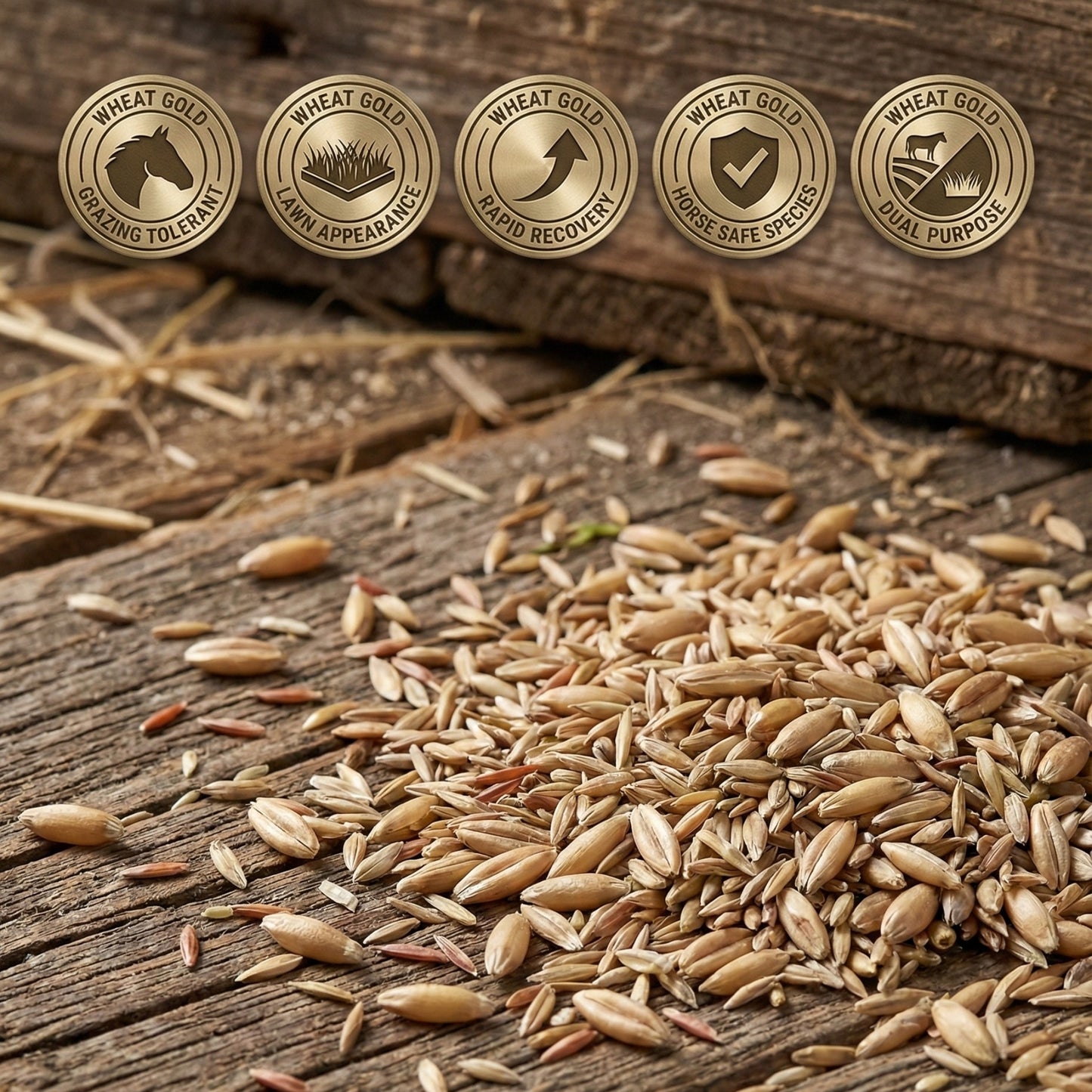
Wicked Tuff Turf Grazing Lawn Seed Mix
Wicked Tuff Turf Grazing Lawn Seed Mix
Couldn't load pickup availability
Product Description
Product Description
What if your lawn could feed your chickens and rabbits too? This dual-purpose blend is designed to do exactly that — look good underfoot and graze well.
Old Cobblers Farm™ Wicked Tuff Turf Grazing Lawn Mix is a dual-purpose cool-season blend that works as an attractive lawn while providing nutritious forage for small livestock, poultry, and rabbits under rotational grazing. The centerpiece is 40% Duo Festulolium — a hybrid grass that brings ryegrass palatability together with fescue persistence, so animals love to eat it and it recovers quickly from grazing pressure.
What is Festulolium?
Festulolium is an intergeneric hybrid between Lolium (ryegrass — fast-establishing, palatable, but short-lived) and Festuca (fescue — persistent and drought-tolerant, but less palatable). “Duo” Festulolium crosses Italian ryegrass with meadow fescue, giving faster establishment than fescue, better persistence than ryegrass, high sugar content (animals prefer it), good drought tolerance, and rapid regrowth after grazing or mowing.
What is tetraploid ryegrass?
“Feast II” annual tetraploid ryegrass has double the normal chromosome count — larger cells mean larger, softer leaves, higher sugar than diploid varieties, more digestible fiber, and faster growth, which is why livestock prefer it over standard ryegrass.
Suitable Animals
• Chickens and poultry — excellent
• Rabbits — excellent
• Ducks and geese — good
• Small goats and sheep — moderate (rotational grazing only; avoid overgrazing)
Key Benefits
• Two uses in one: a usable lawn and a grazing surface from a single planting.
• Palatable, high-sugar forage: Festulolium and tetraploid ryegrass animals favor.
• Fast regrowth: recovers quickly from grazing or mowing.
• Self-repairing: bluegrass rhizomes and bentgrass stolons fill thin areas.
• Rotation-ready: moderate-to-high traffic tolerance for rotational systems.
Best Uses
• Homesteads integrating poultry into yard management
• Hobby farms with small livestock
• Rabbit keepers wanting natural forage
• Permaculture properties using animals for lawn maintenance
• Yards where children and animals share outdoor space
Important Notes
• ⚠ For properties with animals: this is a dual-purpose grazing lawn — if you want a purely ornamental lawn with no animals, choose the Elite Fescue Blend instead (the grazing value is wasted otherwise).
• Rotational grazing only — continuous heavy grazing without rotation will degrade the stand.
• Allow 8–10 weeks of establishment before the first grazing.
• Best in 4–6+ hours of sun (more sun = more forage); not for deep shade.
• Seed only — not a fertilizer (grazing animals return nutrients via manure).
Why Choose Old Cobblers Farm™?
This blend is engineered for a specific lifestyle — a yard shared by people and small animals — pairing high-sugar, fast-recovering Festulolium and tetraploid ryegrass with self-repairing bluegrass and bentgrass and drought-tolerant creeping red fescue, so it grazes well and bounces back.
Application Instructions
Application Instructions
-USDA Zones: 4–7
-Sun: 4–6+ hours ideal; 3–4 minimum (creeping red fescue adds some shade tolerance); more sun = more forage
-Soil pH: 5.8–7.0; adaptable; moderate drainage (tolerates brief wet periods)
Seeding Rate
-Lawn — new: 6–8 lb per 1,000 sq ft; overseeding: 3–4 lb per 1,000 sq ft
-Pasture-style broadcast: 25–35 lb per acre
How to Plant
Rake the seed lightly into the top of the soil for good seed-to-soil contact and keep moist while it establishes (Feast II ryegrass and Festulolium in 5–7 days, Highland bentgrass 10–14, creeping red fescue 14–21, Kentucky bluegrass 21–28). Mow lawns at 3.0–3.5 inches. Nitrogen need is 2–4 lb per 1,000 sq ft a year; Festulolium and ryegrass respond well to nitrogen with more forage, and grazing animals return nutrients via manure, reducing fertilizer demand.
Rotational Grazing Protocol
-Allow grass to reach 4–6 inches before introducing animals
-Remove animals when grazed down to 2–3 inches (prevents overgrazing)
-Rest the area 14–21 days before the next grazing
-Rotate through multiple areas to prevent permanent damage
-Allow 8–10 weeks of establishment before the first grazing
Approximate Stocking
-Chickens: 25–50 birds per 1,000 sq ft in rotation
-Rabbits: 2–4 per 100 sq ft, temporary grazing
-Small ruminants: 1–2 per 1,000 sq ft with careful rotation
Ingredients
Ingredients
-40% Duo Festulolium: Italian ryegrass × meadow fescue hybrid — high sugar, palatable, fast regrowth, persistent
-25% Creeping Red Fescue: fine texture, drought tolerance, some shade tolerance, fills gaps
-20% Kentucky Bluegrass: rhizome self-repair, density, color
-10% Feast II Annual Tetraploid Ryegrass: large, soft, high-sugar, digestible early growth
-5% Highland Bentgrass: stoloniferous growth fills thin areas
Product Specifications
Product Specifications
-Composition: 5-species dual-purpose blend (Festulolium, creeping red fescue, Kentucky bluegrass, tetraploid ryegrass, Highland bentgrass)
-Category: Lawn + forage (dual-purpose) — rotational grazing
-Animals: Poultry/chickens (excellent), rabbits (excellent), ducks/geese (good), small goats/sheep (moderate, rotational)
-Lifecycle: Perennial turf (with annual tetraploid ryegrass component)
-USDA Zones: 4–7
-Sun: 4–6+ hr ideal; 3–4 hr minimum
-Soil pH: 5.8–7.0; adaptable; moderate drainage
-Mowing (lawn): 3.0–3.5 in
-Grazing heights: Introduce at 4–6 in; remove at 2–3 in; rest 14–21 days
-Traffic: Moderate-to-high (recovers from grazing pressure)
-Drought / heat: Moderate (Festulolium + creeping red fescue; Feast II needs moisture)
-NPK: Seed only — not a fertilizer (2–4 lb N/yr; manure returns nutrients)
Seeding & Establishment
-Rate (lawn, new): 6–8 lb / 1,000 sq ft
-Rate (overseeding): 3–4 lb / 1,000 sq ft
-Rate (pasture): 25–35 lb / acre (broadcast)
-Establishment: Initial coverage 2–3 weeks; first grazing 8–10 weeks; mature stand 12–18 months
Share