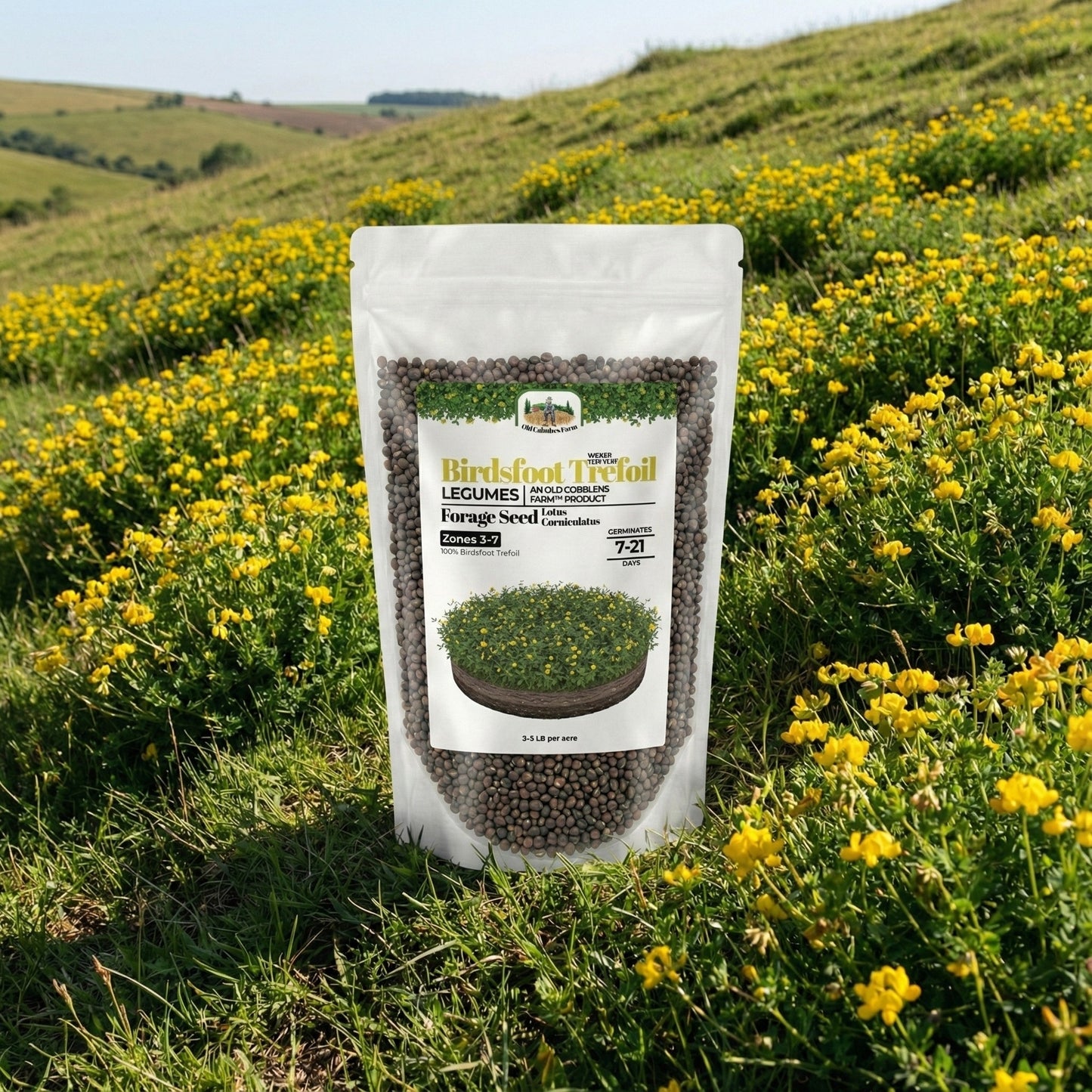
Wicked Tuff Turf Birdsfoot Trefoil Seed
Wicked Tuff Turf Birdsfoot Trefoil Seed
Couldn't load pickup availability
Product Description
Product Description
The safe, tough pasture legume — it won't cause bloat, it thrives on ground that defeats alfalfa, and it comes back on its own for a decade.
Birdsfoot Trefoil (Lotus corniculatus) is a long-lived perennial — a single stand can persist 5–10+ years, reseeding itself to stay dense. Its standout trait is that it is non-bloating: most lush legumes can cause bloat (a dangerous build-up of gas in grazing cattle and sheep), but Birdsfoot Trefoil does not, so you can graze it safely. It also contains condensed tannins — natural plant compounds that are associated with lower internal parasite loads in grazing livestock, which is why organic and low-input graziers value it. As a legume it does nitrogen fixation, pulling 50–100 lbs of nitrogen per acre from the air into the soil. And it tolerates wet, acidic, low-fertility, and moderately salty ground where alfalfa and most clovers fail. Our seed is uncoated and tested for purity and germination.
Key Benefits
• Bloat-safe grazing: one of the few pasture legumes that does not cause bloat in cattle and sheep.
• Natural herd support: condensed tannins are associated with reduced internal parasite loads in grazers.
• Thrives on tough ground: wet, acidic, low-fertility, and moderately saline soils.
• Long-lived & self-reseeding: a productive stand for 5–10+ years.
• Soil builder: fixes 50–100 lbs of nitrogen per acre a year.
• Clean, uncoated seed: no fillers, coatings, or dyes.
Best Uses
• Bloat-safe pasture and grazing systems
• Marginal land improvement and reclamation
• Roadside, conservation, and DOT plantings
• Wildlife food plots and deer habitat
• Low-input, sustainable forage programs
Important Notes
Be patient in year one: Birdsfoot Trefoil establishes slowly compared to clovers. Prepare a firm seedbed, sow shallow (surface to ¼ inch), and plant with a nurse crop such as oats to suppress weeds while it gets going. Full production comes in year two.
Use the right inoculant: Birdsfoot Trefoil needs Mesorhizobium loti, the bacteria specific to Lotus. Clover inoculant (Rhizobium trifolii) will NOT nodulate it, which would mean poor nitrogen fixation. It is a pasture and forage crop, not a residential lawn — it has low foot-traffic tolerance.
Why Choose Old Cobblers Farm™?
Every bag of Wicked Tuff Turf seed is selected for high purity and strong germination, and tested so you know what you are planting — consistent, clean, uncoated seed for growers managing tough ground where other legumes fail.
Application Instructions
Application Instructions
USDA Zones 3–7; full sun to partial shade; clay, sandy, gravelly, or low-fertility soils; pH 5.5–7.5; tolerates poorly drained, moderately wet, and moderately saline ground.
Seeding rate: 6–10 lb per acre for a pure stand; 3–5 lb per acre in a pasture mix.
How to plant
Prepare a firm seedbed and drill or broadcast no deeper than ¼ inch (surface sowing works well). Plant in early spring (preferred) or late summer. It establishes slowly — use a nurse crop such as oats to suppress weeds in year one, and expect full production in year two. Germinates in 7–14 days.
Inoculation
Inoculate before planting with Mesorhizobium loti — the inoculant specific to Lotus. Do NOT use clover inoculant (Rhizobium trifolii); it will not nodulate Birdsfoot Trefoil. Inoculation means coating the seed with the right helper bacteria so the legume can pull nitrogen from the air properly.
Ingredients
Ingredients
Product Specifications
Product Specifications
Species: Birdsfoot Trefoil (Lotus corniculatus)
Category: Legume (nitrogen-fixing, non-bloating)
Lifecycle: Perennial (5–10+ years); reseeds naturally
Growth habit: Semi-prostrate to upright
USDA Zones: 3–7
Sun: Full sun to partial shade
Soil pH: 5.5–7.5 (wider tolerance than alfalfa)
Drainage: Tolerates poorly drained and moderately wet soils
Seeding
Rate — pure stand: 6–10 lb/acre
Rate — in mix: 3–5 lb/acre
Depth: Surface to ¼ inch
Establishment: Slow in year one — use a nurse crop; full production year 2
Best planting time: Early spring (preferred) or late summer
Germination window: 7–14 days (soil 50–70°F)
Inoculant: Mesorhizobium loti (Lotus-specific — not clover inoculant)
Fertilizer note: Seed only — naturally fixes 50–100 lbs N/acre
Seed Quality
Purity: 95–98%
Germination: 85–90%
Weed seed: <0.5%
Other crop seed: ≤0.5%
Inert matter: 2–4%
Share