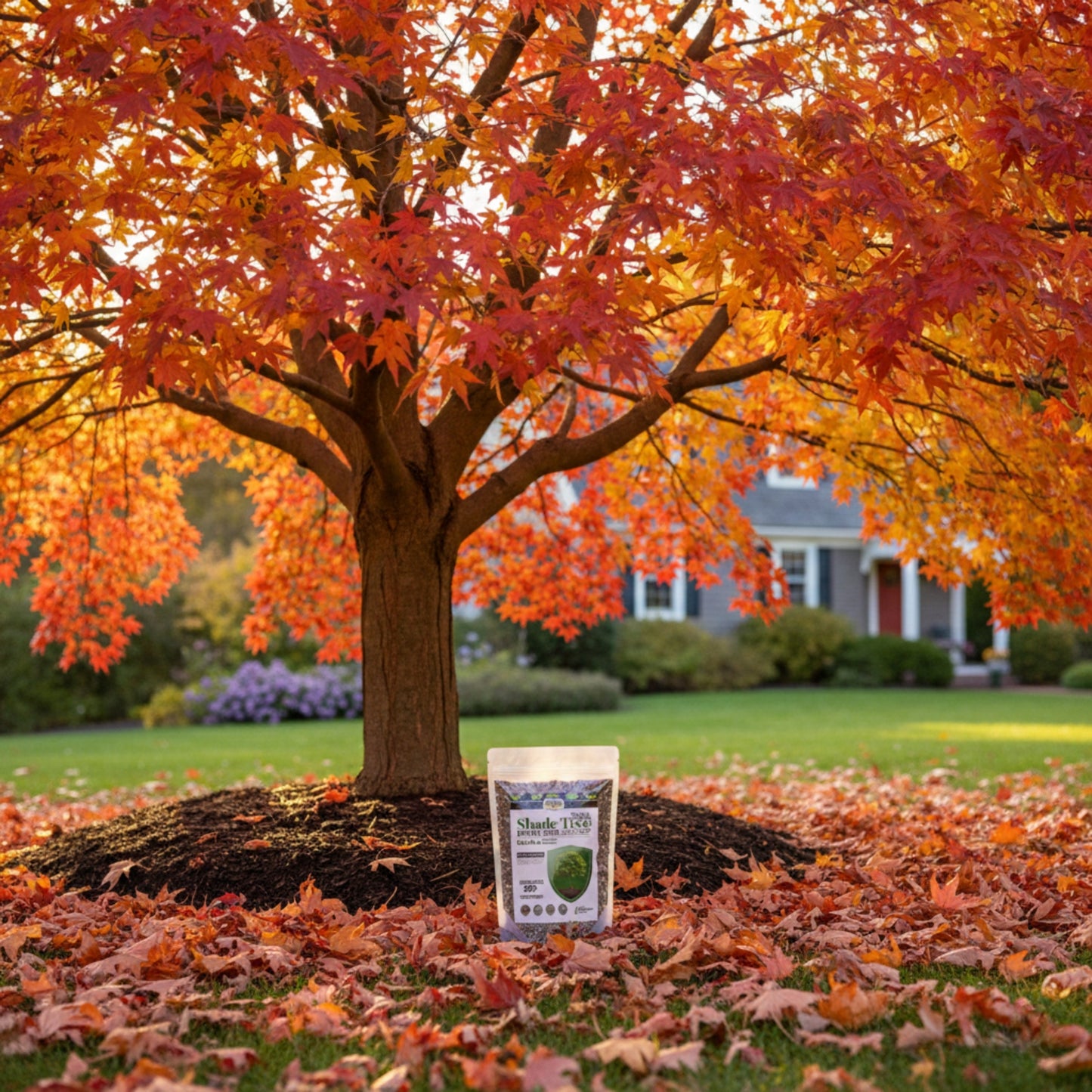
Wicked Growth Shade Trees Fertilizer
Wicked Growth Shade Trees Fertilizer
Couldn't load pickup availability
Product Description
Product Description
Dense Canopies and Deep Green Leaves — A 20-10-10 Formula for Trees in Pots
Old Cobblers Farm Wicked Growth 20-10-10 is a high-nitrogen fertilizer for shade trees grown in containers. The 20-10-10 analysis means it contains 20% nitrogen — double the phosphorus and potassium — to drive vigorous canopy development, deep green leaves, and strong branch structure, with 10% phosphorus supporting the root system and 10% potassium building overall plant resilience.
Trees in pots can't send roots out for more nutrients the way in-ground trees can: they depend entirely on what's in the container, and frequent watering steadily washes nutrients out of the mix. That's why container trees need regular feeding through the growing season — and why this formula uses simple container-size dosing, from 1 tablespoon for a small pot up to ¼ cup for an extra-large planter.
Key Benefits
Built for canopy growth — 20% nitrogen — double the phosphorus and potassium — drives dense canopy development, deep green leaves, and strong branch structure.
Made for life in a pot — Container trees can't forage for nutrients and frequent watering washes them out; a 4–6 week feeding schedule keeps potted trees supplied all season.
Dosing by container size — Four clear rates — 1 tablespoon to ¼ cup — match the dose to the pot, from a patio redbud to an XL planter sycamore.
Roots and resilience included — 10% phosphorus supports the root system and 10% potassium builds resilience, so growth above is matched below.
Scales with your collection — A 5 lb bag feeds roughly 20–80 container trees per application, with 10, 15, and 20 lb sizes for courtyards and bigger collections.
Where to use it: potted and raised-container shade trees on patios, courtyards, balconies, and entryways — including red maple, river birch, tulip tree, American sycamore, littleleaf linden, hackberry, eastern redbud, bald cypress, hornbeam, weeping willow, dwarf and upright elms, zelkova, catalpa, sassafras, sweetgum, Kentucky coffeetree, Osage orange, and black locust.
Application Instructions
Application Instructions
-Medium containers (6–10 gal): 2 tablespoons
-Large containers (11–20 gal): 3 tablespoons
-XL containers (over 20 gal): ¼ cup
Steps:
1. Water first — moisten the soil thoroughly the day before application.
2. Measure the right amount for your container size and sprinkle evenly over the soil surface, staying 2 inches away from the trunk.
3. Lightly mix the fertilizer into the top inch of soil.
4. Water again — deeply — to release nutrients into the root zone.
When and how often:
-Growing season (spring through late summer): apply every 4–6 weeks
-Dormant season (fall and winter): reduce or pause applications
What NOT to do: do not exceed the container-size rates, do not let product touch or pile against the trunk, and do not apply to bone-dry soil — water the day before and water deeply after.
Ingredients
Ingredients
A concentrated, high-analysis nutrient source providing a high-nitrogen 2:1:1 ratio to drive vigorous canopy development, deep green leaves, and strong branch structure. Formulated specifically to fuel container-grown shade trees during the active growing season — pure performance and robust resilience every 4–6 weeks.
Product Specifications
Product Specifications
– Nitrogen (N): 20% — 1 lb per 5 lb bag
– Phosphorus (P): 10% — 0.5 lb per 5 lb bag
– Potassium (K): 10% — 0.5 lb per 5 lb bag
– Total Nutrients: 2 lb per 5 lb bag (40% total analysis)
– Form: granular or powder
– Coverage (5 lb): Feeds approx. 20–80 container trees per application, depending on container size
– Application Rate: 1 tbsp (up to 5 gal) / 2 tbsp (6–10 gal) / 3 tbsp (11–20 gal) / ¼ cup (over 20 gal)
– Feeding Schedule: Every 4–6 weeks, spring through late summer; reduce or pause in fall and winter
– Ideal Soil pH: 6.0–7.5 (slightly acidic to neutral)
Share