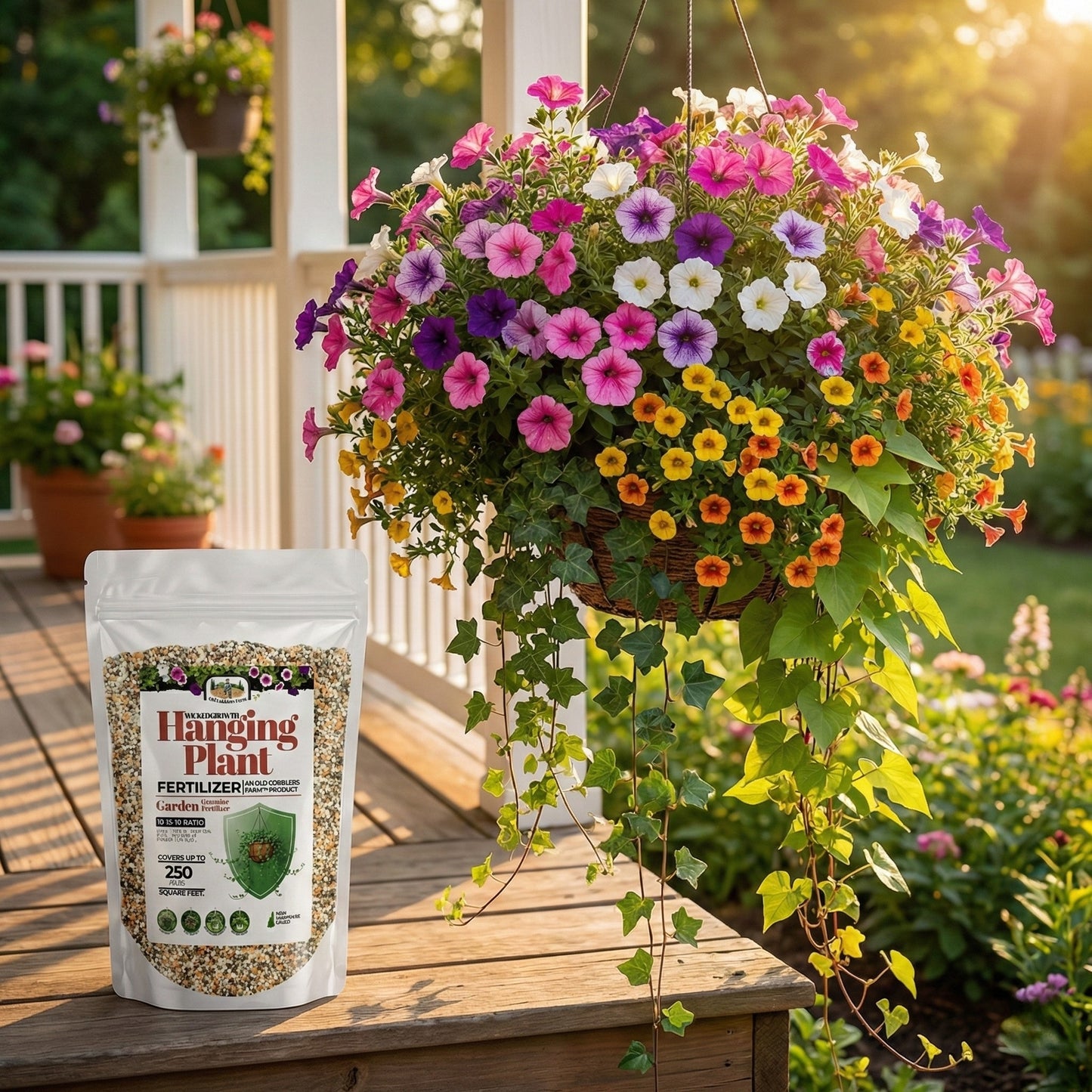
Wicked Growth Hanging Plants Fertilizer
Wicked Growth Hanging Plants Fertilizer
Couldn't load pickup availability
Product Description
Product Description
Full, Cascading, Colorful — Balanced 10-10-10 Feeding for Hanging Baskets
Old Cobblers Farm Wicked Growth 10-10-10 is a balanced fertilizer for hanging baskets and patio planters. The 10-10-10 analysis supplies equal parts of the three major nutrients: 10% nitrogen for the lush, trailing foliage that gives a basket its fullness, 10% phosphorus for the strong roots that keep water and nutrient uptake efficient in a small soil volume, and 10% potassium for the resilience baskets need through heat, wind, and a long season of display.
Hanging baskets work harder than almost any other planting: a dense mix of plants sharing a small volume of potting mix that drains — and loses nutrients — with every watering. Steady feeding every 4–6 weeks replaces what washes out, and the balanced ratio keeps foliage and flowers developing together rather than pushing one at the expense of the other. The simple rate of 1–2 tablespoons per basket means a 5 lb bag feeds an entire season of porch and patio displays.
Key Benefits
Balanced for the whole basket — Equal 10-10-10 nitrogen, phosphorus, and potassium keep trailing foliage and flowers developing together — full baskets, not just leafy or just leggy ones.
Made for limited soil — Baskets lose nutrients with every watering; feeding every 4–6 weeks at 1–2 tablespoons replaces exactly what a small soil volume can't hold.
Season-long staying power — 10% potassium builds the resilience baskets need through summer heat, wind exposure, and months of continuous display.
Every basket on the porch — One bag feeds petunias, geraniums, fuchsias, impatiens, begonias, calibrachoa, lobelia, trailing greens, and mixed arrangements.
Effortless feeding — Fast-acting granules dissolve with normal watering — sprinkle, scratch in, water, done.
Goes a very long way — A 5 lb bag feeds roughly 80–160 baskets per application — a whole season for most homes, with sizes up to 20 lb for big seasonal displays.
Where to use it: hanging baskets, window boxes, patio planters, and container gardens planted with petunias, geraniums, fuchsias, impatiens, begonias, calibrachoa (Million Bells), lobelia, ivy and trailing greens, and mixed flowering arrangements.
Application Instructions
Application Instructions
-Liquid feeding option: the granules can be dissolved in water for liquid feeding.
1. Measure 1–2 tablespoons for the basket's size.
2. Sprinkle evenly over the soil surface, keeping granules off leaves and flowers and away from direct contact with stems.
3. Work lightly into the top of the potting mix with your fingers or a small fork.
4. Water thoroughly so the fast-acting granules dissolve and feed the roots.
5. Repeat every 4–6 weeks through the display season.
What NOT to do: do not exceed the rate — baskets hold very little soil and over-application concentrates quickly; do not leave granules sitting on foliage; and do not skip the watering-in step.
Ingredients
Ingredients
-Diammonium Phosphate / DAP (10–20%) — Supplies phosphorus for root strength and efficient water and nutrient uptake, plus a secondary nitrogen contribution.
-Potassium Chloride (40–50%) — Also called muriate of potash; the potassium source that builds resilience through heat and a long display season.
Product Specifications
Product Specifications
– Nitrogen (N): 10% — 0.5 lb per 5 lb bag
– Phosphorus (P): 10% — 0.5 lb per 5 lb bag
– Potassium (K): 10% — 0.5 lb per 5 lb bag
– Total Nutrients: 1.5 lb per 5 lb bag (30% total analysis)
– Form: Granular, fast-acting; can be dissolved for liquid feeding
– Coverage (5 lb): Feeds approx. 80–160 baskets per application
– Application Rate: 1–2 tbsp per basket
– Feeding Schedule: Every 4–6 weeks through the display season
Share