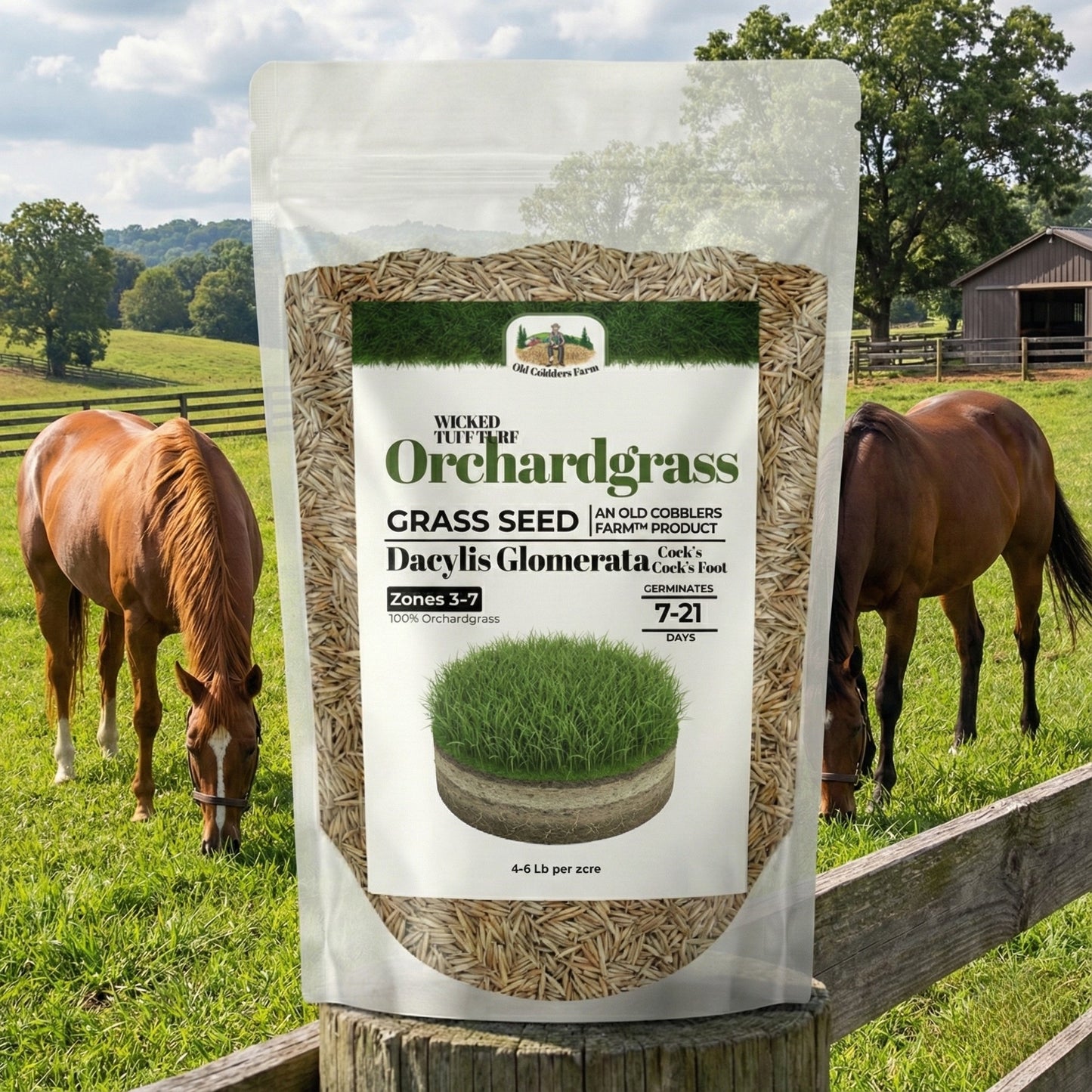
Wicked Tuff Turf Orchardgrass Seed
Wicked Tuff Turf Orchardgrass Seed
Couldn't load pickup availability
Product Description
Product Description
Maximize your forage tonnage in sun or shade — the most productive cool-season forage grass, and the one that actually thrives under tree canopy.
Orchardgrass (Dactylis glomerata), called Cocksfoot in Europe, is a cool-season perennial — it grows in the cooler parts of the year and a stand lasts 5–10+ years. It is a bunch-type grass (it grows in upright tufts) that is tall and early-maturing, with deep, fibrous roots. Two things make it stand out. First, shade: it is the best-performing cool-season forage grass under tree canopy, which makes it the premier choice for silvopasture, orchards, and wooded grazing. Second, productivity: it produces the earliest spring growth of the common forage grasses, recovers fast after cutting or grazing, and yields high tonnage across 3–4+ harvests a season — more than Timothy or Bromegrass. Its deep roots also give it better drought tolerance than Timothy or Perennial Ryegrass, and it blends beautifully with legumes for high-protein forage. Our seed is uncoated and tested for purity and germination.
Key Benefits
• The ultimate shade specialist: the best cool-season forage grass for shaded and wooded pasture.
• Earliest spring growth: the first fresh forage of the season.
• Superior yield: 3–4+ high-tonnage harvests per year.
• Drought-resilient: deep fibrous roots outperform Timothy and ryegrass.
• Excellent legume companion: pairs with alfalfa and clover for high-protein systems.
• Clean, uncoated seed: no fillers, coatings, or dyes.
Best Uses
• Hay and silage production
• Silvopasture and orchard-floor cover
• Rotational grazing pastures
• Mixed-species forage blends with legumes
• Shaded pasture and woodland grazing
Important Notes
Timing is the make-or-break with Orchardgrass. It matures early and fast, and its quality drops rapidly once it heads out, so cut at the boot to early head stage for the best feed value. Under grazing, it can become stemmy and coarse if left unmanaged — rotational grazing is essential to keep it leafy and palatable. This is an agricultural forage and silvopasture grass, not a residential lawn or turf.
Why Choose Old Cobblers Farm™?
Every bag of Wicked Tuff Turf seed is selected for high purity and strong germination, and tested so you know what you are planting — consistent, clean, uncoated seed for hay and pasture producers who want maximum tonnage, including from shaded ground.
Application Instructions
Application Instructions
USDA Zones 3–8; full sun to moderate shade; loam, clay loam, or sandy loam; pH 5.5–7.0; well-drained to moderately moist.
Seeding rate
15–20 lb per acre for a pure stand; 6–10 lb per acre in a mix with legumes (a recommended blend is 50–60% Orchardgrass / 40–50% legume).
How to plant
Drill or broadcast ¼–½ inch deep on a prepared seedbed. Plant late summer/early fall (preferred) or early spring. Keep moist through the 10–14 day germination.
Cutting & grazing
Harvest at boot to early head stage for maximum quality — it drops rapidly after heading. Use rotational grazing to prevent it from becoming stemmy and coarse.
Ingredients
Ingredients
Product Specifications
Product Specifications
Species: Orchardgrass / Cocksfoot (Dactylis glomerata)
Category: Cool-season perennial forage/hay grass
Lifecycle: Perennial (5–10+ year stand life)
Growth habit: Bunch-type; tall, upright, early-maturing
Root system: Deep, fibrous — good drought tolerance
USDA Zones: 3–8
Sun: Full sun to moderate shade (best forage grass for shade)
Soil pH: 5.5–7.0
Seeding & care
Rate — pure stand: 15–20 lb/acre
Rate — with legumes: 6–10 lb/acre
Depth: ¼–½ inch
Best planting time: Late summer/early fall (preferred) or early spring
Germination window: 10–14 days (soil 50–65°F)
First harvest: Early to mid-spring — 2–3 weeks ahead of Timothy
Cutting: Boot to early head stage (quality drops fast after heading)
Fertility note: Seed only — grass (not a fertilizer); responds to nitrogen
Seed quality
Purity: 95–98%
Germination: 85–90%
Weed seed: <0.5%
Other crop seed: ≤0.5%
Inert matter: 2–4%
Share