Wicked Tuff Turf Low Grow Seed Mix
Wicked Tuff Turf Low Grow Seed Mix
Couldn't load pickup availability
Product Description
Product Description
Tired of mowing every weekend? This blend is built to cut that roughly in half — honestly, without overpromising a lawn you never have to touch.
Old Cobblers Farm™ Wicked Tuff Turf Low Grow Mix is a reduced-mowing cool-season blend (“cool-season” = grasses that grow most in spring and fall). It’s anchored by 40% hard fescue — the slowest-growing, lowest-maintenance member of the fine-fescue family — with 30% perennial ryegrass and 30% named Kentucky bluegrass added for the density, color, and traffic tolerance a pure fine-fescue lawn lacks.
What “hard fescue” means
Hard fescue is an upright, bunch-type fine fescue that grows slowly (8–12 inches tall if never mowed, but it keeps an acceptable 4–6 inch look). It’s exceptionally drought-tolerant — surviving on natural rainfall in most cool-season climates — tolerates poor, acidic, infertile soils, and has the lowest nitrogen requirement of any cool-season turfgrass. The trade-off is that it establishes very slowly.
What “named” Kentucky bluegrass means
“Named” means a specific improved cultivar (variety) rather than generic common bluegrass or VNS (Variety Not Stated) seed. Named varieties bring better disease resistance, improved color and density, and more predictable performance than common seed.
The reduced-mowing reality (please read)
This is less mowing, not no mowing — it typically cuts mowing 30–50%, not 100%. In peak season (roughly May–June and Sept–Oct) you mow every 10–14 days instead of weekly; in summer, growth slows to every 2–3 weeks; and the spring flush may need more frequent mowing until growth stabilizes. The goal is “less mowing,” and a tidy, natural look — not a putting-green or HOA-manicured finish.
Key Benefits
• Mow less: about 30–50% fewer mows in peak season.
• Drought-tolerant: hard fescue is exceptionally drought-tolerant.
• Low feed: the lowest nitrogen need of any bluegrass mix.
• Tough enough: ryegrass and named bluegrass add density and moderate traffic tolerance.
• Eco-friendly upside: fewer mows means less fuel and fewer emissions.
Best Uses
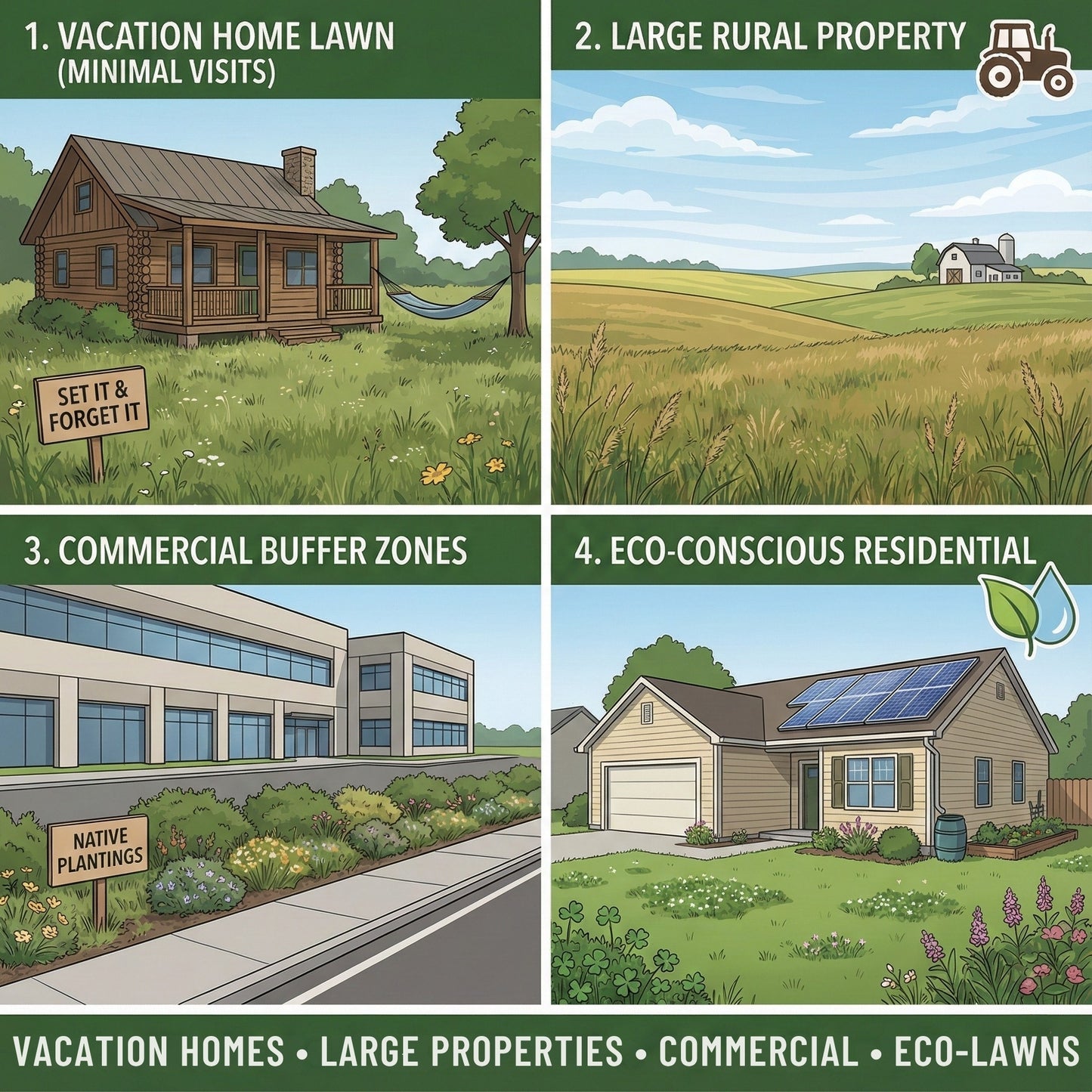
• Large properties where mowing is time-consuming
• Vacation homes, secondary residences, and rentals
• Eco-conscious, low-input lawn approaches
• Areas where weekly mowing isn’t practical
• Overseeding to slow the mowing treadmill on an existing lawn
Important Notes
• ⚠ Less mowing, not no-mow: expect a tidy, natural, low-input look — not a putting-green-short or HOA-manicured lawn.
• ⚠ Slow to establish: hard fescue is the slowest turfgrass to fill in — quick early ryegrass green-up, but a mature stand takes 18–24 months. Patience required.
• Traffic is moderate — not for sports or fast-recovery, high-wear areas (hard fescue is the weak link).
• Don’t over-fertilize — excess nitrogen speeds growth and defeats the low-grow purpose; one fall feeding is often enough.
• Seed only — not a fertilizer.
Why Choose Old Cobblers Farm™?
This blend is built for a simple, honest goal — less time mowing — by anchoring a naturally slow-growing hard fescue with just enough ryegrass and named bluegrass for density and durability. It’s a low-input, drought-tolerant lawn for people who’d rather enjoy the yard than cut it.
Application Instructions
Application Instructions
-USDA Zones: 3–7
-Sun: 4–6 hours ideal; 3 hours minimum (hard fescue tolerates moderate shade); full sun (8+ hr) acceptable, may thin slightly
-Soil pH: 5.5–7.0; adaptable — hard fescue tolerates poor, infertile soils; moderate-to-good drainage
Seeding Rate (per 1,000 sq ft and per acre)
-New lawns: 5–6 lb per 1,000 sq ft (≈ 220–260 lb per acre)
-Overseeding: 3–4 lb per 1,000 sq ft (≈ 130–175 lb per acre)
How to Plant
Rake the seed lightly into the top of the soil for good seed-to-soil contact — do not bury deep — and keep moist while it establishes. Expect ryegrass in 5–10 days, bluegrass 14–21, and hard fescue slowest at 21–35 days; initial coverage takes 3–4 weeks, a mowable lawn 5–7 weeks, and a fully mature stand 18–24 months. Maintain at 3.5–4.5 inches (3.0 in minimum), letting the grass reach up to 5–6 inches between mows; mow every 10–14 days during peak growth. Feed lightly — 1–2 lb nitrogen per 1,000 sq ft a year, often a single fall application. Avoid excess nitrogen: it speeds growth and defeats the reduced-mowing purpose.
Ingredients
Ingredients
-40% Hard Fescue: slow-growing fine fescue — drought-tolerant, lowest maintenance, anchors the low-grow habit
-30% Perennial Ryegrass: quick establishment, density, traffic tolerance
-30% Named Kentucky Bluegrass: improved cultivar — color, density, rhizome self-repair
No fillers, coatings, or dyes.
Product Specifications
Product Specifications
-Composition: 3-species blend (40% hard fescue, perennial ryegrass, named Kentucky bluegrass)
-Category: Lawn Mix (turf) — reduced-mowing
-Lifecycle: Perennial turf
-USDA Zones: 3–7
-Sun: Full to partial sun (4–6 hr ideal; 3 hr minimum; full sun OK)
-Soil pH: 5.5–7.0; tolerates poor/infertile soils
-Texture: Fine, dense
-Mowing: 3.5–4.5 in; every 10–14 days peak (vs. weekly); up to 5–6 in between mows — NOT no-mow
-Traffic: Moderate — not for sports/fast-recovery (hard fescue is the weak link)
-Drought / heat: Excellent drought tolerance (hard fescue); good heat tolerance
-Maintenance / N: Low — 1–2 lb N / 1,000 sq ft / yr (lowest of any bluegrass mix)
-NPK: Seed only — not a fertilizer
Seeding & Establishment
-Rate (new lawn): 5–6 lb / 1,000 sq ft (≈ 220–260 lb/acre)
-Rate (overseeding): 3–4 lb / 1,000 sq ft (≈ 130–175 lb/acre)
-Establishment: Initial coverage 3–4 weeks; mowable 5–7 weeks; mature stand 18–24 months (slowest in the line)
Seed Quality
-Kentucky bluegrass: Named (improved cultivar) — better than common/VNS; numeric grade not provided
-Blend purity: no fillers/coatings/dyes
Share