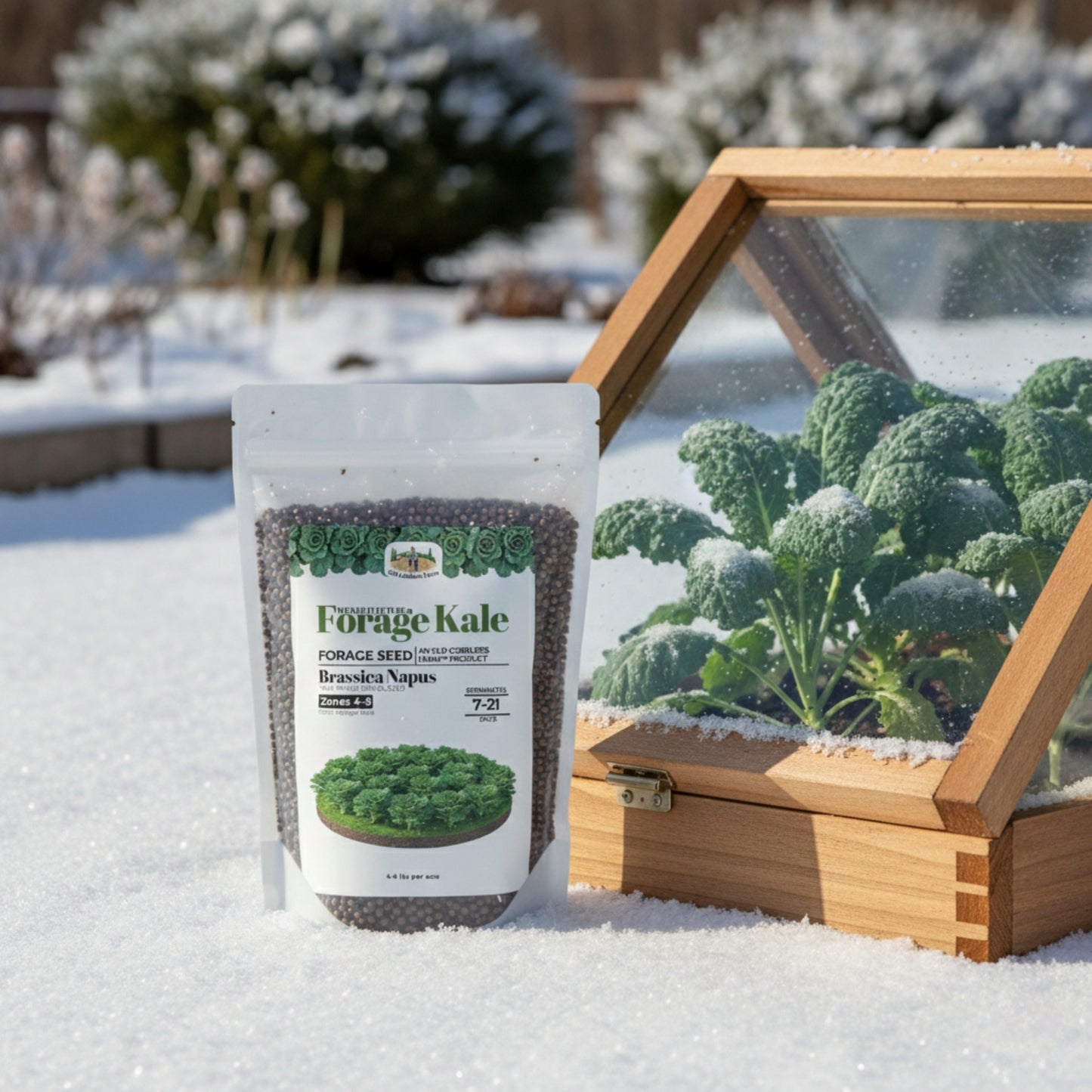
Wicked Tuff Turf Kale Seed
Wicked Tuff Turf Kale Seed
Couldn't load pickup availability
Product Description
Product Description
The ultimate standing winter feed — a tall, cold-proof brassica that stays green through snow and ice and feeds livestock and deer when everything else has frozen off.
Forage Kale (Brassica oleracea var. acephala), also called Borecole, Kail, Curly Kale, or Fodder Kale, is an annual-to-biennial brassica grown as standing winter forage. Its defining trait is cold tolerance: where turnips and radishes melt away after a few hard frosts, kale stands tall — 3 to 5 feet — through ice and snow, and its palatability actually improves after frost. It produces exceptional tonnage per acre (often the highest dry-matter yield of any forage brassica), with high protein (about 15–20% crude protein) and energy. That makes it a “standing hayloft” for cattle, sheep, and goats deep into winter, and a powerful late-season magnet for deer once other food sources have died off. Our seed is uncoated and tested for purity and germination.
Key Benefits
• Unmatched cold tolerance: green and nutritious through hard frost, snow, and ice.
• Massive tonnage: outyields almost all other forage brassicas in dry matter.
• Standing winter feed: a 3–5 ft “hayloft” that cuts stored-hay costs.
• High-protein nutrition: about 15–20% crude protein and high energy.
• Late-season deer magnet: primary food once other vegetation freezes; sweeter after frost.
• Clean, uncoated seed: no fillers, coatings, or dyes.
Best Uses
• Winter livestock grazing extension
• Deer and wildlife food plots (late-season attraction)
• High-tonnage forage production
• Cold-climate cover crop and soil health
• Emergency winter feed reserve
Plan Your Timing
Kale is slower to mature than turnips or mustard — it needs 90–150 days to reach grazing readiness — so plant earlier, from late spring to mid-summer, counting back 90–150 days from when you want to start using it. That long runway is the trade-off for its tonnage and standing winter durability, so it rewards planning ahead more than the quicker brassicas do.
How to Graze It
Strip-graze for best utilization — give animals access to one section at a time so they consume the whole plant and waste less. Introduce livestock to brassica grazing gradually, with other forage or fiber available alongside, since a sudden switch to a heavy brassica diet can upset rumen digestion. For deer plots, simply plant and let the frost sweeten the leaves.
Important Notes
This is an agricultural fodder crop, not a backyard salad kale. It is a brassica, so rotate thoughtfully — avoid following other brassicas (turnip, rape, radish, canola) back-to-back to prevent clubroot and other brassica disease buildup. During establishment, watch for aphids, cabbage worms, and flea beetles.
Why Choose Old Cobblers Farm™?
Every bag of Wicked Tuff Turf seed is selected for high purity and strong germination, and tested so you know what you are planting — consistent, clean, uncoated seed for producers and food-plot managers who graze the snow.
Application Instructions
Application Instructions
USDA Zones 3–9; full sun; fertile, well-drained loam, silt loam, or clay loam; pH 5.5–7.0. Responds strongly to good fertility.
Seeding rate
Pure stand 4–6 lb per acre; food plots 4–6 lb per acre; in mixes 2–3 lb per acre.
How to plant
Drill or broadcast ¼–½ inch deep into a prepared seedbed. Plant late spring to mid-summer, about 90–150 days before the first expected freeze (kale matures slower than turnips). Keep moist through germination and the seedling stage.
Grazing management
Strip-graze for best utilization — animals consume the whole plant with less waste. Introduce brassica grazing gradually with other forage available. For deer plots, plant and let frost sweeten the leaves.
Ingredients
Ingredients
Product Specifications
Product Specifications
Species: Forage Kale (Brassica oleracea var. acephala)
Category: Annual/biennial forage brassica / food plot
Lifecycle: Annual to biennial
Growth habit: Tall, upright, leafy — 3–5 ft at maturity
Forage type: Standing leaf forage; stems eaten after frost softening
USDA Zones: 3–9
Sun: Full sun
Soil pH: 5.5–7.0
Seeding & timing
Rate — pure stand: 4–6 lb/acre
Rate — food plots: 4–6 lb/acre
Rate — in mixes: 2–3 lb/acre
Depth: ¼–½ inch
Best planting time: Late spring to mid-summer (90–150 days before use)
Germination window: 5–10 days (soil 45–75°F)
Grazing readiness: 90–150 days; peak value late fall through winter after frost
Fertility note: Seed only — brassica forage (not a fertilizer); responds to high fertility
Seed quality
Purity: 95–98%
Germination: 85–90%
Weed seed: <0.5%
Other crop seed: ≤0.5%
Inert matter: 2–4%
Share