Wicked Tuff Turf Hillside Stabilizer Seed
Wicked Tuff Turf Hillside Stabilizer Seed
Couldn't load pickup availability
Product Description
Product Description
A slope that keeps washing out doesn’t need a pretty lawn — it needs roots that hold. This blend is engineered for exactly that job.
Old Cobblers Farm™ Wicked Tuff Turf Hillside Stabilizer is an erosion-control blend for slopes, banks, and disturbed soil — not an ornamental lawn. Unlike a turf mix, it prioritizes root development, soil binding, and survival in tough conditions over appearance. It pairs fast, soil-holding grasses with two nitrogen-fixing legumes that keep the stand going on poor soils without regular fertilizer.
Why this species mix
• Creeping Red Fescue (43%): spreads via rhizomes to knit soil together; tolerates shade from nearby plants; low maintenance.
• Perennial Ryegrass (33%): fast establishment for immediate erosion protection; fibrous roots stabilize the surface.
• Redtop (8%): a native grass (Agrostis gigantea) that colonizes wet, acidic, and compacted soils where finer grasses fail. It’s coarse and aggressive — “weedy” for a lawn, but exactly what you want for stabilization.
• Alsike Clover (8%): a nitrogen-fixing legume that tolerates wetter, acidic soils (pH 5.5+).
• Empire Birdsfoot Trefoil (8%): a perennial legume with a deep 3–4 ft taproot that anchors slopes and accesses deep moisture; fixes 80–150 lb nitrogen per acre a year; yellow flowers (May–Sept) benefit pollinators.
Key Benefits
• Holds slopes: spreading and deep roots anchor and bind disturbed soil.
• Self-sustaining: 16% nitrogen-fixing legumes mean little to no fertilizer once established.
• Wet and dry: trefoil and fescue handle drought; Redtop and alsike clover take seasonally wet ground.
• Very low maintenance: often left unmowed; minimal long-term upkeep.
• Pollinator-friendly: trefoil’s summer flowers support pollinators.
Best Uses
• Slopes and banks over 15% grade
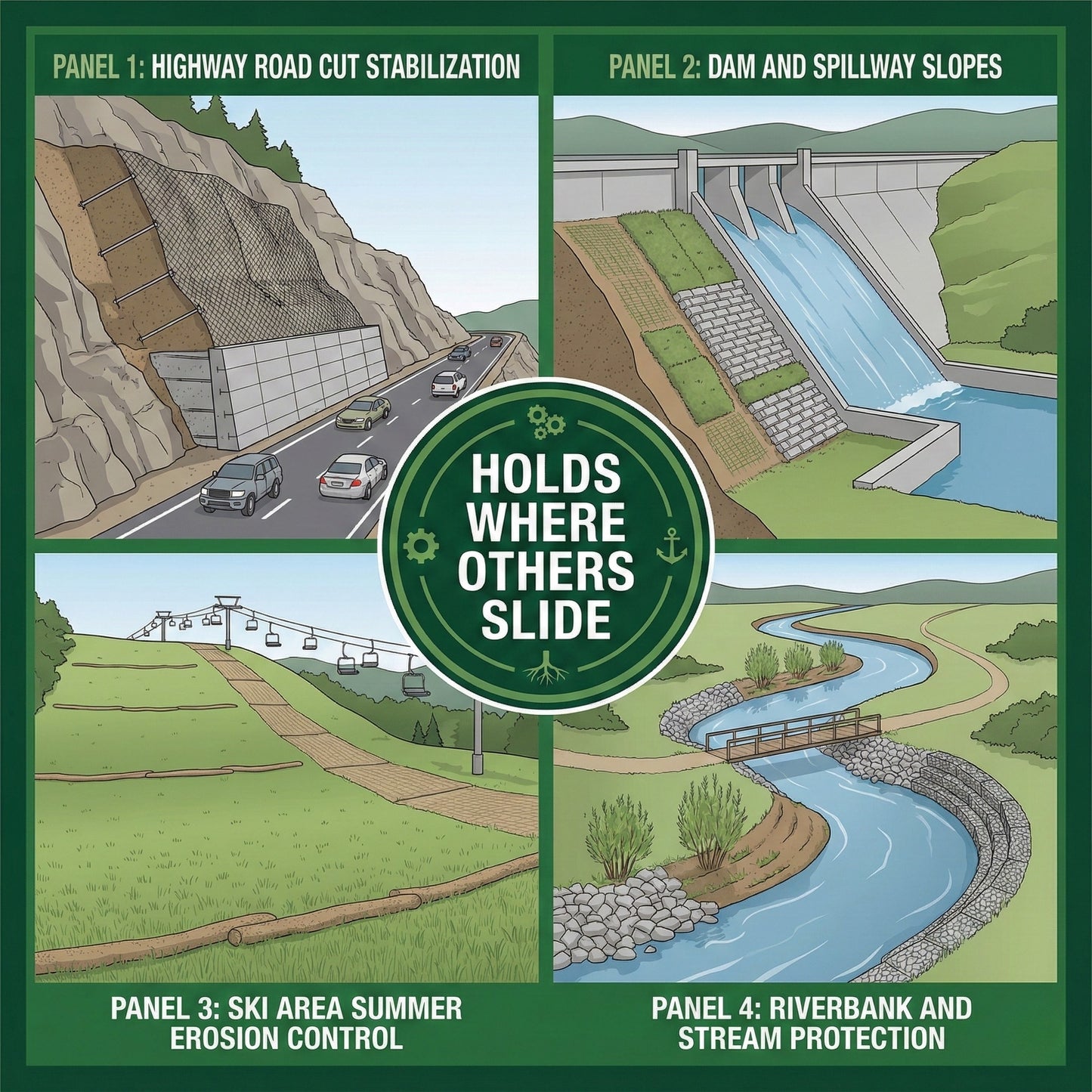
• Highway and roadway cuts and fills
• Retention-pond banks and swales
• Stream banks (above the normal water line)
• Construction sites, ditches, and any disturbed soil needing stabilization
Important Notes
• ⚠ Alsike clover — toxic to horses: this mix contains alsike clover, which can be toxic to horses. Do not use it where horses will graze.
• ⚠ Not an ornamental lawn: with coarse Redtop and legume flowers it looks rugged and naturalistic (“weedy”), not manicured. Choose a turf mix for high-visibility lawns.
• Traffic tolerance is low — it’s not for foot paths; slopes shouldn’t be walked or mowed regularly anyway (use stepping stones or a defined path if needed).
• Many slope plantings are left unmowed (stabilizes at 8–18 inches); if mowing, keep it at 3.5–4.5 inches, infrequently.
• Legumes need at least 4 hours of sun for nitrogen fixation.
• Seed only — not a fertilizer.
Why Choose Old Cobblers Farm™?
This blend is purpose-built for a hard job — stabilizing slopes and disturbed soil where ordinary lawn seed fails — combining fast, soil-binding grasses, a tough colonizer in Redtop, and deep-rooted nitrogen-fixing legumes for a self-sustaining, very-low-maintenance cover.
Application Instructions
Application Instructions
-USDA Zones: 3–7
-Sun: 4–6 hours ideal; 3 hours minimum (creeping red fescue adds shade tolerance); legumes need ≥4 hours for nitrogen fixation
-Soil pH: 5.5–7.0; adaptable — selected for clay, compacted, and disturbed ground; tolerates both wet and dry extremes
Seeding Rate
-Standard slopes: 6–8 lb per 1,000 sq ft (≈ 260–350 lb per acre)
-Steep slopes (>30%): 8–10 lb per 1,000 sq ft
-Hydroseeding: 100–150 lb per acre with appropriate mulch/tackifier
Slope Gradient Guidance
-15–30% grade: seed, rake, roll; use an erosion blanket if budget allows
-30–50% grade: erosion blanket strongly recommended; consider hydroseeding
-Over 50% grade: hydroseeding with tackifier required (seed alone will wash away)
-Erosion blankets: install after seeding, staple at 1-ft intervals on slopes over 30%; biodegradable blankets decompose in 12–24 months as vegetation establishes
How to Plant
Loosen the soil surface, broadcast the seed evenly across the slope, and lightly rake or roll for good seed-to-soil contact; water consistently until established. Perennial ryegrass emerges in 5–10 days and Redtop in 7–14 for quick early protection; creeping red fescue and alsike clover follow in 14–21 days; birdsfoot trefoil is slow (21–35 days) but persistent. Established stands need essentially no nitrogen (0–1 lb per 1,000 sq ft a year) thanks to the legumes; a low-nitrogen, high-phosphorus starter at seeding can help initial establishment. The legumes are uncoated (not pre-inoculated) — for best nitrogen fixation use the correct inoculants: Rhizobium trifolii for the clover and a Lotus-type (Mesorhizobium loti) inoculant for the birdsfoot trefoil.
Ingredients
Ingredients
-43% Creeping Red Fescue: rhizomes knit soil together; shade tolerance; low maintenance
-33% Perennial Ryegrass: fast establishment; fibrous surface roots for immediate protection
-8% Redtop: tough colonizer of wet/acidic/compacted soils; coarse and aggressive (a strength for stabilization)
-8% Alsike Clover: nitrogen-fixing legume; tolerates wetter, acidic soils (toxic to horses — see notes)
-8% Empire Birdsfoot Trefoil: deep-taproot nitrogen-fixing legume; slope anchoring; pollinator flowers
No fillers or coatings. Legumes are uncoated (not pre-inoculated).
Product Specifications
Product Specifications
-Composition: 5-species erosion-control blend (fescue, ryegrass, Redtop, 16% legume)
-Category: Erosion control / slope stabilization (NOT an ornamental lawn)
-Grazing: Not a forage/pasture mix — contains alsike clover (toxic to horses); do not graze with horses
-Lifecycle: Perennial (with perennial legumes)
-USDA Zones: 3–7
-Sun: 4–6 hr ideal; 3 hr minimum (legumes need ≥4 hr)
-Soil: pH 5.5–7.0; clay/compacted/disturbed; tolerates wet AND dry extremes
-Mowing: Often unmowed (stabilizes 8–18 in); if mowing, 3.5–4.5 in, infrequent
-Traffic: Low — not designed for foot traffic
-Drought / heat: Moderate-to-good drought (trefoil taproot); moderate heat
-NPK: Seed only — not a fertilizer; 16% legumes fix nitrogen (0–1 lb N/yr needed)
Seeding & Establishment
-Rate (standard slope): 6–8 lb / 1,000 sq ft (≈ 260–350 lb/acre)
-Rate (steep >30%): 8–10 lb / 1,000 sq ft
-Hydroseeding: 100–150 lb/acre with mulch/tackifier
-Establishment: Initial protection 2–4 weeks; roots 3–6 months; full stabilization 12–24 months
Seed Quality
-Purity: no fillers/coatings
-Legume treatment: Uncoated — not pre-inoculated (clover: R. trifolii; trefoil: Lotus/M. loti inoculant)
Share